| ⇦ | 
| ⇨ |
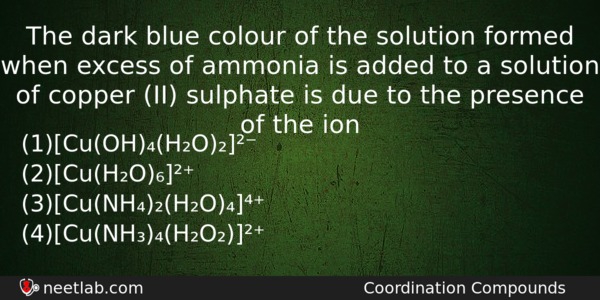
The dark blue colour of the solution formed when excess of ammonia is added to a solution of copper (II) sulphate is due to the presence of the ion
Options
(a) [Cu(OH)₄(H₂O)₂]²⁻
(b) [Cu(H₂O)₆]²⁺
(c) [Cu(NH₄)₂(H₂O)₄]⁴⁺
(d) [Cu(NH₃)₄(H₂O₂)]²⁺
Correct Answer:
[Cu(NH₃)₄(H₂O₂)]²⁺
Explanation:
when excess of ammonia is added to a solution of copper (II) sulphate, then the complex compound, [Cu(NH₃)₄(H₂O₂)]SO₄ is formed which causes the formation of deep blue colour.
Related Questions: - Which one of the following is an example of thermosetting polymer
- Volume occupied by one molecule of water (density= 1 g cm⁻³) is
- The most suitable method of the separation of a 1:1 mixture of ortho-and para
- In a period, the elements are arranged in strict sequence of
- Chloride ion and potassium ion are isoelectronic. Then
Topics: Coordination Compounds
(87)
Subject: Chemistry
(2512)
Important MCQs Based on Medical Entrance Examinations To Improve Your NEET Score
- Which one of the following is an example of thermosetting polymer
- Volume occupied by one molecule of water (density= 1 g cm⁻³) is
- The most suitable method of the separation of a 1:1 mixture of ortho-and para
- In a period, the elements are arranged in strict sequence of
- Chloride ion and potassium ion are isoelectronic. Then
Topics: Coordination Compounds (87)
Subject: Chemistry (2512)
Important MCQs Based on Medical Entrance Examinations To Improve Your NEET Score
18000+ students are using NEETLab to improve their score. What about you?
Solve Previous Year MCQs, Mock Tests, Topicwise Practice Tests, Identify Weak Topics, Formula Flash cards and much more is available in NEETLab Android App to improve your NEET score.

Share this page with your friends
Leave a Reply