| ⇦ | 
| ⇨ |
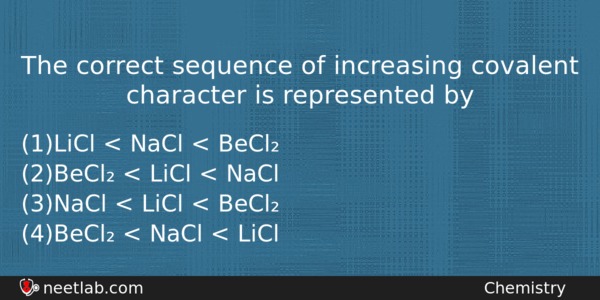
The correct sequence of increasing covalent character is represented by
Options
(a) LiCl < NaCl < BeCl₂
(b) BeCl₂ < LiCl < NaCl
(c) NaCl < LiCl < BeCl₂
(d) BeCl₂ < NaCl < LiCl
Correct Answer:
NaCl < LiCl < BeCl₂
Explanation:
As difference of electronegativity increases % ionic character increases and covalentcharacter decreases i.e. negativity differences decreases covalent character increases.
Further greater the charge on the cation more will be its covalent character.Be has maximum (+2) charge.
Related Questions: - How many mole of MNO₄⁻ ion will react with 1 mole of ferrous oxalate in acidic medium
- Which one of the following is the heaviest
- Which of the following statement is true for an electrochemical cell
- Which responds to +ve iodoform test
- Which type of bond is there in H₂S molecules
Question Type: Memory
(964)
Difficulty Level: Easy
(1008)
Topics: Chemical Bonding and Molecular Structure
(86)
Subject: Chemistry
(2512)
Important MCQs Based on Medical Entrance Examinations To Improve Your NEET Score
- How many mole of MNO₄⁻ ion will react with 1 mole of ferrous oxalate in acidic medium
- Which one of the following is the heaviest
- Which of the following statement is true for an electrochemical cell
- Which responds to +ve iodoform test
- Which type of bond is there in H₂S molecules
Question Type: Memory (964)
Difficulty Level: Easy (1008)
Topics: Chemical Bonding and Molecular Structure (86)
Subject: Chemistry (2512)
Important MCQs Based on Medical Entrance Examinations To Improve Your NEET Score
18000+ students are using NEETLab to improve their score. What about you?
Solve Previous Year MCQs, Mock Tests, Topicwise Practice Tests, Identify Weak Topics, Formula Flash cards and much more is available in NEETLab Android App to improve your NEET score.

Share this page with your friends
Leave a Reply