| ⇦ | 
| ⇨ |
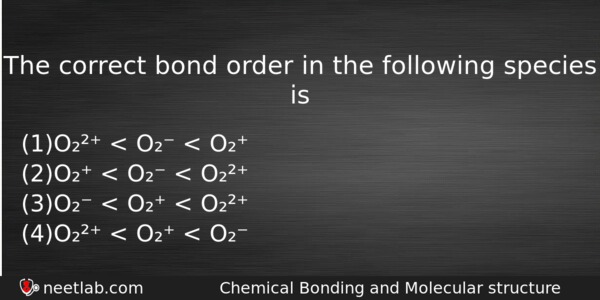
The correct bond order in the following species is
Options
(a) O₂²⁺ < O₂⁻ < O₂⁺
(b) O₂⁺ < O₂⁻ < O₂²⁺
(c) O₂⁻ < O₂⁺ < O₂²⁺
(d) O₂²⁺ < O₂⁺ < O₂⁻
Correct Answer:
O₂⁻ < O₂⁺ < O₂²⁺
Explanation:
O₂⁺ ion -Total number of electrons (16-1)=15.
Electronic configuration σ1s² < σ*1s² < σ2s² < σ*2s² < σ2p²(x) < π2p²(y)=π2p²(z)< π*2p¹(y)
Bond order =N(b)-N(a)/2 = 10-5/2 = 5/2 =2 1/2 O⁻₂ (super oxide ion): Total number of electrons (16+1)=17
Electronic configuration σ1s² < σ*1s² < σ2s² < σ*2s² < σ2p²(x) < π2p²(y)=π2p²(z)< π*2p² (y)=π*2p¹(z)
Bond order =N(b)-N(a)/2 = 10-7/2 = 3/2 =1 1/2
O₂⁺² ion :Total number of electrons (16-2)=14.
Electronic configuration σ1s² < σ*1s² < σ2s² < σ*2s² < σ2p²(x) < π2p²(y)=π2p²(z)
Bond order =N(b)-N(a)/2 = 10-4/2 = 6/2 =3
So bond order :O⁻₂ <O₂⁺<O₂²⁺
Related Questions: - Which of the following statements about amorphous solids is incorrect
- Oxidation state of oxygen atom in potassium peroxide is
- Numbers of moles of K₂Cr₂O₇ reduced by one mole os Sn²⁺
- If 0.189g of chlorine containing organic compound gave 0.287g of silver chloride
- In an equilibrium reaction, if temperature increases
Topics: Chemical Bonding and Molecular Structure
(86)
Subject: Chemistry
(2512)
Important MCQs Based on Medical Entrance Examinations To Improve Your NEET Score
- Which of the following statements about amorphous solids is incorrect
- Oxidation state of oxygen atom in potassium peroxide is
- Numbers of moles of K₂Cr₂O₇ reduced by one mole os Sn²⁺
- If 0.189g of chlorine containing organic compound gave 0.287g of silver chloride
- In an equilibrium reaction, if temperature increases
Topics: Chemical Bonding and Molecular Structure (86)
Subject: Chemistry (2512)
Important MCQs Based on Medical Entrance Examinations To Improve Your NEET Score
18000+ students are using NEETLab to improve their score. What about you?
Solve Previous Year MCQs, Mock Tests, Topicwise Practice Tests, Identify Weak Topics, Formula Flash cards and much more is available in NEETLab Android App to improve your NEET score.

Share this page with your friends
Leave a Reply