| ⇦ | 
| ⇨ |
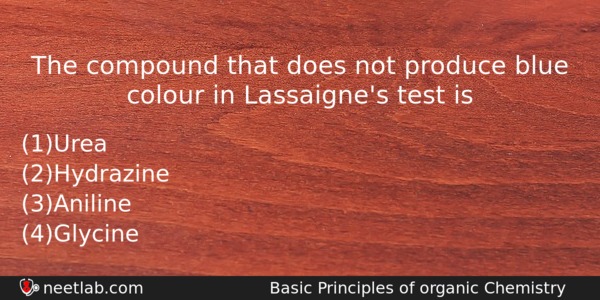
The compound that does not produce blue colour in Lassaigne’s test is
Options
(a) Urea
(b) Hydrazine
(c) Aniline
(d) Glycine
Correct Answer:
Hydrazine
Explanation:
No explanation available. Be the first to write the explanation for this question by commenting below.
Related Questions: - The hydrogen ion concentration in mol/dm, in a 0.2 M solution of a weak acid
- Which of the following is a basic dye
- MnO₄²⁻ (1 mole) in neutral aqueous medium is disproportionated to
- Colligative properties of solution are those properties which depend on the
- What is the equivalent mass of IO₄⁻ when it is converted into I₂ in acid medium
Topics: Basic Principles of Organic Chemistry
(124)
Subject: Chemistry
(2512)
Important MCQs Based on Medical Entrance Examinations To Improve Your NEET Score
- The hydrogen ion concentration in mol/dm, in a 0.2 M solution of a weak acid
- Which of the following is a basic dye
- MnO₄²⁻ (1 mole) in neutral aqueous medium is disproportionated to
- Colligative properties of solution are those properties which depend on the
- What is the equivalent mass of IO₄⁻ when it is converted into I₂ in acid medium
Topics: Basic Principles of Organic Chemistry (124)
Subject: Chemistry (2512)
Important MCQs Based on Medical Entrance Examinations To Improve Your NEET Score
18000+ students are using NEETLab to improve their score. What about you?
Solve Previous Year MCQs, Mock Tests, Topicwise Practice Tests, Identify Weak Topics, Formula Flash cards and much more is available in NEETLab Android App to improve your NEET score.

Share this page with your friends
Leave a Reply