| ⇦ | 
| ⇨ |
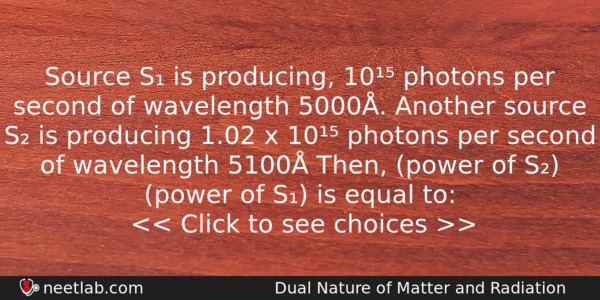
Source S₁ is producing, 10¹⁵ photons per second of wavelength 5000Å. Another source S₂ is producing 1.02 x 10¹⁵ photons per second of wavelength 5100Å Then, (power of S₂) (power of S₁) is equal to:
Options
(a) 1
(b) 1.02
(c) 1.04
(d) 0.98
Correct Answer:
1
Explanation:
energy emitted/sec by S₁, P₁ = n₁ hc / λ₁
energy emitted/sec by S₂, P₂ = n₂ hc / λ₂
P₂ / P₁ = n₂ / n₁ . λ₁ / λ₂
= 1.02 x 10¹⁵ / 10¹⁵ . 5000 / 5100 = 1.0
Related Questions: - The motion of a particle along a straight line is described by equation
- A particle of mass m executes simple harmonic motion with amplitude
- Two strings A and B, made of same material are stretched by same tension
- The de-Broglie wavelength of an electron moving with a velocity 1.5×10⁸ ms⁻¹ is equal
- Steam at 100⁰C is passed into 20 g of water at 10°C. When water acquires a temperature
Topics: Dual Nature of Matter and Radiation
(150)
Subject: Physics
(2479)
Important MCQs Based on Medical Entrance Examinations To Improve Your NEET Score
- The motion of a particle along a straight line is described by equation
- A particle of mass m executes simple harmonic motion with amplitude
- Two strings A and B, made of same material are stretched by same tension
- The de-Broglie wavelength of an electron moving with a velocity 1.5×10⁸ ms⁻¹ is equal
- Steam at 100⁰C is passed into 20 g of water at 10°C. When water acquires a temperature
Topics: Dual Nature of Matter and Radiation (150)
Subject: Physics (2479)
Important MCQs Based on Medical Entrance Examinations To Improve Your NEET Score
18000+ students are using NEETLab to improve their score. What about you?
Solve Previous Year MCQs, Mock Tests, Topicwise Practice Tests, Identify Weak Topics, Formula Flash cards and much more is available in NEETLab Android App to improve your NEET score.

Share this page with your friends
Leave a Reply