| ⇦ | 
| ⇨ |
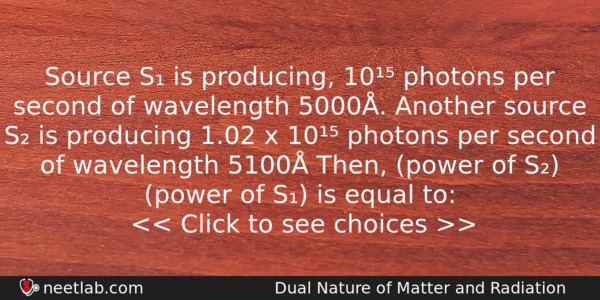
Source S₁ is producing, 10¹⁵ photons per second of wavelength 5000Å. Another source S₂ is producing 1.02 x 10¹⁵ photons per second of wavelength 5100Å Then, (power of S₂) (power of S₁) is equal to:
Options
(a) 1
(b) 1.02
(c) 1.04
(d) 0.98
Correct Answer:
1
Explanation:
energy emitted/sec by S₁, P₁ = n₁ hc / λ₁
energy emitted/sec by S₂, P₂ = n₂ hc / λ₂
P₂ / P₁ = n₂ / n₁ . λ₁ / λ₂
= 1.02 x 10¹⁵ / 10¹⁵ . 5000 / 5100 = 1.0
Related Questions: - A sphere of 4cm radius is suspended with in a hollow sphere of 6cm radius. If the inner
- The oscillating frequency of a cyclotron is 10 MHz. If the radius of its Dees is o.5 m,
- The escape velocity from the earth is Ve. The escape velocity from a planet
- Given the value of Rydberg constant is 10⁷ m⁻¹, the wave number of the last line
- The area of cross-section of a steel wire (Y=2.0×10¹¹ N/m²) is 0.1 cm².
Topics: Dual Nature of Matter and Radiation
(150)
Subject: Physics
(2479)
Important MCQs Based on Medical Entrance Examinations To Improve Your NEET Score
- A sphere of 4cm radius is suspended with in a hollow sphere of 6cm radius. If the inner
- The oscillating frequency of a cyclotron is 10 MHz. If the radius of its Dees is o.5 m,
- The escape velocity from the earth is Ve. The escape velocity from a planet
- Given the value of Rydberg constant is 10⁷ m⁻¹, the wave number of the last line
- The area of cross-section of a steel wire (Y=2.0×10¹¹ N/m²) is 0.1 cm².
Topics: Dual Nature of Matter and Radiation (150)
Subject: Physics (2479)
Important MCQs Based on Medical Entrance Examinations To Improve Your NEET Score
18000+ students are using NEETLab to improve their score. What about you?
Solve Previous Year MCQs, Mock Tests, Topicwise Practice Tests, Identify Weak Topics, Formula Flash cards and much more is available in NEETLab Android App to improve your NEET score.

Share this page with your friends
Leave a Reply