| ⇦ | 
| ⇨ |
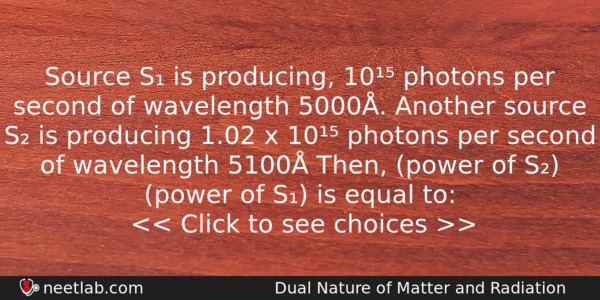
Source S₁ is producing, 10¹⁵ photons per second of wavelength 5000Å. Another source S₂ is producing 1.02 x 10¹⁵ photons per second of wavelength 5100Å Then, (power of S₂) (power of S₁) is equal to:
Options
(a) 1
(b) 1.02
(c) 1.04
(d) 0.98
Correct Answer:
1
Explanation:
energy emitted/sec by S₁, P₁ = n₁ hc / λ₁
energy emitted/sec by S₂, P₂ = n₂ hc / λ₂
P₂ / P₁ = n₂ / n₁ . λ₁ / λ₂
= 1.02 x 10¹⁵ / 10¹⁵ . 5000 / 5100 = 1.0
Related Questions: - 1 Wb/m² equal to
- The condition under which a microwave oven heats up a food item containing
- If Q, E and W denote respectively the heat added, change in internal energy
- A radioactive sample S₁ having an activity of 5 μCi has twice the number of nuclei
- An ideal black body is equivalent to
Topics: Dual Nature of Matter and Radiation
(150)
Subject: Physics
(2479)
Important MCQs Based on Medical Entrance Examinations To Improve Your NEET Score
- 1 Wb/m² equal to
- The condition under which a microwave oven heats up a food item containing
- If Q, E and W denote respectively the heat added, change in internal energy
- A radioactive sample S₁ having an activity of 5 μCi has twice the number of nuclei
- An ideal black body is equivalent to
Topics: Dual Nature of Matter and Radiation (150)
Subject: Physics (2479)
Important MCQs Based on Medical Entrance Examinations To Improve Your NEET Score
18000+ students are using NEETLab to improve their score. What about you?
Solve Previous Year MCQs, Mock Tests, Topicwise Practice Tests, Identify Weak Topics, Formula Flash cards and much more is available in NEETLab Android App to improve your NEET score.

Share this page with your friends
Leave a Reply