| ⇦ | 
| ⇨ |
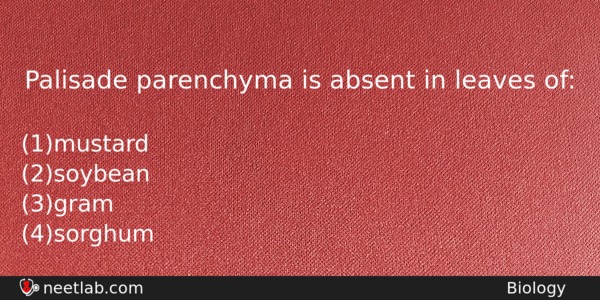
Palisade parenchyma is absent in leaves of:
Options
(a) mustard
(b) soybean
(c) gram
(d) sorghum
Correct Answer:
sorghum
Explanation:
Palisade parenchyma is absent in leaves of Sorghum. It is a leaf tissue composed of columnar cells containing numerous chloroplasts in which the long axis of each cell is perpendicular to the leaf surface. The palisade parenchyma is usually directly beneath the epidermis of the upper surface of the leaf. The cells of the palisade parenchyma are cylindrical. Neighbouring cells look like the stakes of a palisade. Cells of the palisade parenchyma contain three to five times as many chloroplasts as those of the
Related Questions: - Which one of the following pairs is wrongly matched? Ginkgo -Archegonia
- As temperature changes from 3°C to 45°C, the rate of enzyme activity will
- Man in the life cycle of plasmodium is
- A common structural feature of vessel elements and sieve tube element is
- How many ATP molecules are produced by aerobic oxidation of one molecule of
Question Type: Memory
(964)
Difficulty Level: Easy
(1008)
Topics: Structural Organisation In Plants
(243)
Subject: Biology
(4253)
Important MCQs Based on Medical Entrance Examinations To Improve Your NEET Score
- Which one of the following pairs is wrongly matched? Ginkgo -Archegonia
- As temperature changes from 3°C to 45°C, the rate of enzyme activity will
- Man in the life cycle of plasmodium is
- A common structural feature of vessel elements and sieve tube element is
- How many ATP molecules are produced by aerobic oxidation of one molecule of
Question Type: Memory (964)
Difficulty Level: Easy (1008)
Topics: Structural Organisation In Plants (243)
Subject: Biology (4253)
Important MCQs Based on Medical Entrance Examinations To Improve Your NEET Score
18000+ students are using NEETLab to improve their score. What about you?
Solve Previous Year MCQs, Mock Tests, Topicwise Practice Tests, Identify Weak Topics, Formula Flash cards and much more is available in NEETLab Android App to improve your NEET score.

Share this page with your friends
Leave a Reply