| ⇦ | 
| ⇨ |
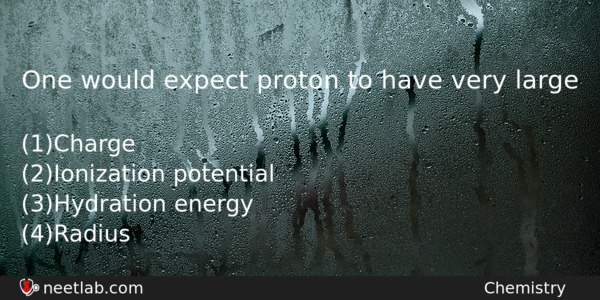
One would expect proton to have very large
Options
(a) Charge
(b) Ionization potential
(c) Hydration energy
(d) Radius
Correct Answer:
Hydration energy
Explanation:
Proton (H+) being very small in size wouldhave very large hydration energy.
Related Questions: - The two polypeptide chains present in insulin contain which of the following number
- The best coagulant for the precipitation of Fe(OH)₃ is
- Which of the following lanthanide is commonly used
- The strength of H₂O₂ (in g/litre) in 11.2 volume solution of H₂O₂ is
- In the Kjeldahl’s method for estimation of nitrogen present in a soil sample
Question Type: Memory
(964)
Difficulty Level: Easy
(1008)
Topics: Classification of Elements and Periodicity
(94)
Subject: Chemistry
(2512)
Important MCQs Based on Medical Entrance Examinations To Improve Your NEET Score
- The two polypeptide chains present in insulin contain which of the following number
- The best coagulant for the precipitation of Fe(OH)₃ is
- Which of the following lanthanide is commonly used
- The strength of H₂O₂ (in g/litre) in 11.2 volume solution of H₂O₂ is
- In the Kjeldahl’s method for estimation of nitrogen present in a soil sample
Question Type: Memory (964)
Difficulty Level: Easy (1008)
Topics: Classification of Elements and Periodicity (94)
Subject: Chemistry (2512)
Important MCQs Based on Medical Entrance Examinations To Improve Your NEET Score
18000+ students are using NEETLab to improve their score. What about you?
Solve Previous Year MCQs, Mock Tests, Topicwise Practice Tests, Identify Weak Topics, Formula Flash cards and much more is available in NEETLab Android App to improve your NEET score.

Share this page with your friends
Leave a Reply