| ⇦ | 
| ⇨ |
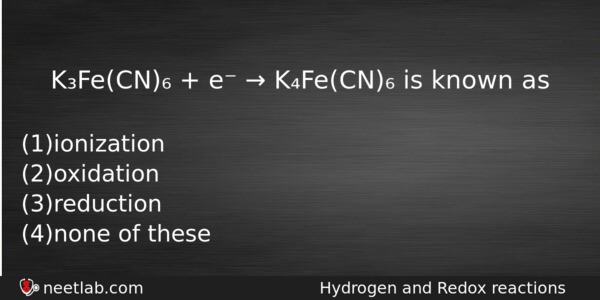
K₃Fe(CN)₆ + e⁻ → K₄Fe(CN)₆ is known as
Options
(a) ionization
(b) oxidation
(c) reduction
(d) none of these
Correct Answer:
reduction
Explanation:
No explanation available. Be the first to write the explanation for this question by commenting below.
Related Questions: - The oxidation states of sulphur in the anions : SO₃²⁻,S₂O₄²⁻ and S₂O₆²⁻
- Rectified spirit has ethanol
- In the Kjeldahl’s method for estimation of nitrogen present in a soil sample
- In the manufacture of sulphuric acid by contact process, Tyndall box is used to
- If 900 J/g of heat is exchanged at boiling point of water, then what is increase
Topics: Hydrogen and Redox Reactions
(174)
Subject: Chemistry
(2512)
Important MCQs Based on Medical Entrance Examinations To Improve Your NEET Score
- The oxidation states of sulphur in the anions : SO₃²⁻,S₂O₄²⁻ and S₂O₆²⁻
- Rectified spirit has ethanol
- In the Kjeldahl’s method for estimation of nitrogen present in a soil sample
- In the manufacture of sulphuric acid by contact process, Tyndall box is used to
- If 900 J/g of heat is exchanged at boiling point of water, then what is increase
Topics: Hydrogen and Redox Reactions (174)
Subject: Chemistry (2512)
Important MCQs Based on Medical Entrance Examinations To Improve Your NEET Score
18000+ students are using NEETLab to improve their score. What about you?
Solve Previous Year MCQs, Mock Tests, Topicwise Practice Tests, Identify Weak Topics, Formula Flash cards and much more is available in NEETLab Android App to improve your NEET score.

Share this page with your friends
Leave a Reply