| ⇦ | 
| ⇨ |
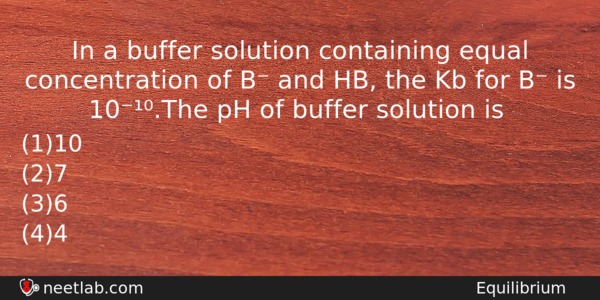
In a buffer solution containing equal concentration of B⁻ and HB, the Kb for B⁻ is 10⁻¹⁰.The pH of buffer solution is
Options
(a) 10
(b) 7
(c) 6
(d) 4
Correct Answer:
4
Explanation:
We know, pOH = pK(b) + log{[B⁻]/[HB]},
Since, [B⁻] = [HB] (given).
Therefore pOH = pK(b) ⇒ pOH = 10,
Therefore pH = 14 – 10 = 4.
Related Questions: - Which of the following is paramagnetic
- The pair of compounds that can exist together is
- What is the approximate percentage of H₂O₂ in a sample labelled as 10 V?
- Complexes with bidentate ligands are called
- The flame colours of metals ions are due to
Topics: Equilibrium
(104)
Subject: Chemistry
(2512)
Important MCQs Based on Medical Entrance Examinations To Improve Your NEET Score
- Which of the following is paramagnetic
- The pair of compounds that can exist together is
- What is the approximate percentage of H₂O₂ in a sample labelled as 10 V?
- Complexes with bidentate ligands are called
- The flame colours of metals ions are due to
Topics: Equilibrium (104)
Subject: Chemistry (2512)
Important MCQs Based on Medical Entrance Examinations To Improve Your NEET Score
18000+ students are using NEETLab to improve their score. What about you?
Solve Previous Year MCQs, Mock Tests, Topicwise Practice Tests, Identify Weak Topics, Formula Flash cards and much more is available in NEETLab Android App to improve your NEET score.

Share this page with your friends
Leave a Reply