| ⇦ | 
| ⇨ |
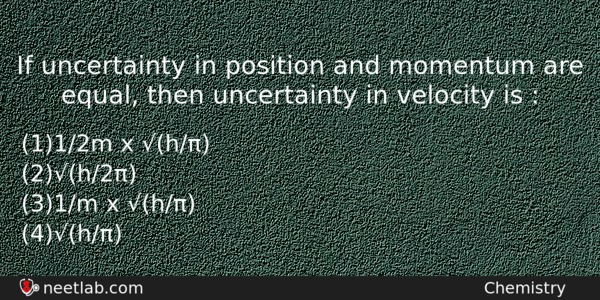
If uncertainty in position and momentum are equal, then uncertainty in velocity is :
Options
(a) 1/2m x √(h/π)
(b) √(h/2π)
(c) 1/m x √(h/π)
(d) √(h/π)
Correct Answer:
1/2m x √(h/π)
Explanation:
We known Δp.Δx ≥ h / 4π
or m.Δv.Δx = h / 4π [ .·. Δp = mΔV]
since Δp = Δx (given)
.·. Δp.Δp = h / 4π or mΔv = h / 4π
or (Δv)² = h / 4πm²
or Δv = √ h / 4πm² = 1 / 2 m √ h / π..
Related Questions: - Use of chlorofluoro carbons is not encouraged because
- A solution with pH = 2 is more acidic then one with a pH = 6 , by a factor
- What is the pressure of 64g O₂ enclosed in a cylinder of 20 litres at 27⁰C
- Which of the following species has plane triangular shape
- An alkane with a molecular formula C₆H₁₄ reacts with chlorine in the presence
Question Type: Memory
(964)
Difficulty Level: Easy
(1008)
Topics: Structure of Atom
(90)
Subject: Chemistry
(2512)
Important MCQs Based on Medical Entrance Examinations To Improve Your NEET Score
- Use of chlorofluoro carbons is not encouraged because
- A solution with pH = 2 is more acidic then one with a pH = 6 , by a factor
- What is the pressure of 64g O₂ enclosed in a cylinder of 20 litres at 27⁰C
- Which of the following species has plane triangular shape
- An alkane with a molecular formula C₆H₁₄ reacts with chlorine in the presence
Question Type: Memory (964)
Difficulty Level: Easy (1008)
Topics: Structure of Atom (90)
Subject: Chemistry (2512)
Important MCQs Based on Medical Entrance Examinations To Improve Your NEET Score
18000+ students are using NEETLab to improve their score. What about you?
Solve Previous Year MCQs, Mock Tests, Topicwise Practice Tests, Identify Weak Topics, Formula Flash cards and much more is available in NEETLab Android App to improve your NEET score.

Share this page with your friends
We Know that, Δx.Δp ≥ h/4π,
∵ x = p
we can find answer with using two formulae,
first- Δx.Δp ≥ h/4π,
second- Δx.Δv ≥ h/4mπ.
Here, Δx = Δp = y
According to Heisenberg’s uncertainty principle
Δx*Δp = h/4π
y² = h/4π
y = √h/√4π
y = 1/2 √h/√π
So p(Momentum) = 1/2 √h/√π = mΔv
1/2 √h/√π = mΔv
1/2m √h/√π = Δv
So ans is….. Δv = 1/2m √h/√π