| ⇦ | 
| ⇨ |
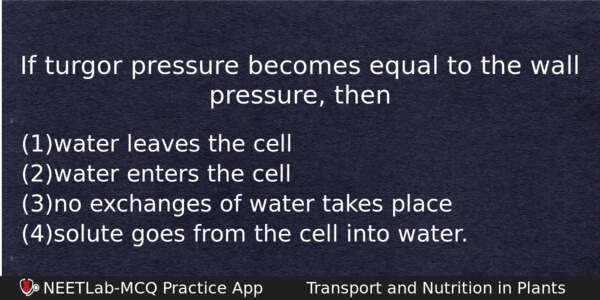
If turgor pressure becomes equal to the wall pressure, then
Options
(a) water leaves the cell
(b) water enters the cell
(c) no exchanges of water takes place
(d) solute goes from the cell into water.
Correct Answer:
no exchanges of water takes place
Explanation:
When water enters the cell of a plant cytoplasm and exerts an outward pressure then that pressure is called turgor pressure. Cell wall is rigid and flexible therefore exerts an equal and opposite wall pressure against the expanding protoplasm. Thus turgor pressure becomes equal to the wall pressure when no exchange of water takes place and equilibrium is established.
Related Questions: - Select the correct statement from the following regarding cell membrane.
- The annular and spirally thickened conducting elements generally develop in the protoxylem
- One of the exsitu conservation methods for endangered species is
- Induction of flowering by low temperature treatment is
- Most of the water, in mature plant cells, occurs chiefly in which of the following?
Topics: Transport and Nutrition in Plants
(163)
Subject: Biology
(4253)
Important MCQs Based on Medical Entrance Examinations To Improve Your NEET Score
- Select the correct statement from the following regarding cell membrane.
- The annular and spirally thickened conducting elements generally develop in the protoxylem
- One of the exsitu conservation methods for endangered species is
- Induction of flowering by low temperature treatment is
- Most of the water, in mature plant cells, occurs chiefly in which of the following?
Topics: Transport and Nutrition in Plants (163)
Subject: Biology (4253)
Important MCQs Based on Medical Entrance Examinations To Improve Your NEET Score
18000+ students are using NEETLab to improve their score. What about you?
Solve Previous Year MCQs, Mock Tests, Topicwise Practice Tests, Identify Weak Topics, Formula Flash cards and much more is available in NEETLab Android App to improve your NEET score.

Share this page with your friends
Leave a Reply