| ⇦ | 
| ⇨ |
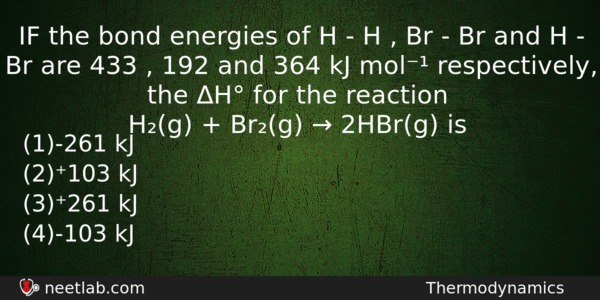
IF the bond energies of H – H , Br – Br and H – Br are 433 , 192 and 364 kJ mol⁻¹ respectively, the ΔH° for the reaction
H₂(g) + Br₂(g) → 2HBr(g) is
Options
(a) -261 kJ
(b) ⁺103 kJ
(c) ⁺261 kJ
(d) -103 kJ
Correct Answer:
-103 kJ
Explanation:
H – H + Br – Br → 2H – Br,
(433) + (192) (2 x 364)
=625 =728
(Energyabsorbed) (Energy released)
Net energy released = 728 – 625 = 103 KJ. i.e. ΔH = -103 KJ.
Related Questions: - An aqueous solution of glucose is 10% in strength. The volume in which 1g mole
- Which of the following is not a cheracteristic of equilibrium
- Helium atom is two times heavier than a hydrogen molecule, the average kinetic energy
- Which of the following alkyl halide is used as a methylating agent
- Hydrolysis of an ester in an alkaline medium is
Topics: Thermodynamics
(179)
Subject: Chemistry
(2512)
Important MCQs Based on Medical Entrance Examinations To Improve Your NEET Score
- An aqueous solution of glucose is 10% in strength. The volume in which 1g mole
- Which of the following is not a cheracteristic of equilibrium
- Helium atom is two times heavier than a hydrogen molecule, the average kinetic energy
- Which of the following alkyl halide is used as a methylating agent
- Hydrolysis of an ester in an alkaline medium is
Topics: Thermodynamics (179)
Subject: Chemistry (2512)
Important MCQs Based on Medical Entrance Examinations To Improve Your NEET Score
18000+ students are using NEETLab to improve their score. What about you?
Solve Previous Year MCQs, Mock Tests, Topicwise Practice Tests, Identify Weak Topics, Formula Flash cards and much more is available in NEETLab Android App to improve your NEET score.

Share this page with your friends
Leave a Reply