| ⇦ | 
| ⇨ |
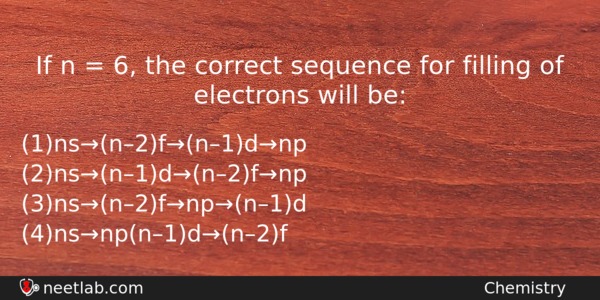
If n = 6, the correct sequence for filling of electrons will be:
Options
(a) ns→(n–2)f→(n–1)d→np
(b) ns→(n–1)d→(n–2)f→np
(c) ns→(n–2)f→np→(n–1)d
(d) ns→np(n–1)d→(n–2)f
Correct Answer:
ns→(n–2)f→(n–1)d→np
Explanation:
No explanation available. Be the first to write the explanation for this question by commenting below.
Related Questions: - The maximum number of hydrogen bonds formed by a water molecule in ice is
- When chloroform is exposed to light and air, it forms
- The ionisation potential for hydrogen atom is 13.6eV, the ionization potential for He⁺
- The isomerism represented by ethyl acetoacetate is
- Which of the following is an alicyclic compound
Question Type: Memory
(964)
Difficulty Level: Easy
(1008)
Topics: Structure of Atom
(90)
Subject: Chemistry
(2512)
Important MCQs Based on Medical Entrance Examinations To Improve Your NEET Score
- The maximum number of hydrogen bonds formed by a water molecule in ice is
- When chloroform is exposed to light and air, it forms
- The ionisation potential for hydrogen atom is 13.6eV, the ionization potential for He⁺
- The isomerism represented by ethyl acetoacetate is
- Which of the following is an alicyclic compound
Question Type: Memory (964)
Difficulty Level: Easy (1008)
Topics: Structure of Atom (90)
Subject: Chemistry (2512)
Important MCQs Based on Medical Entrance Examinations To Improve Your NEET Score
18000+ students are using NEETLab to improve their score. What about you?
Solve Previous Year MCQs, Mock Tests, Topicwise Practice Tests, Identify Weak Topics, Formula Flash cards and much more is available in NEETLab Android App to improve your NEET score.

Share this page with your friends
Leave a Reply