| ⇦ | 
| ⇨ |
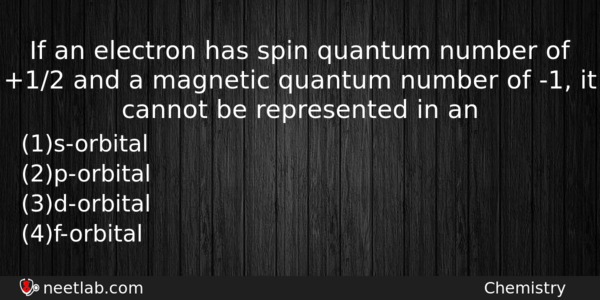
If an electron has spin quantum number of +1/2 and a magnetic quantum number of -1, it cannot be represented in an
Options
(a) s-orbital
(b) p-orbital
(c) d-orbital
(d) f-orbital
Correct Answer:
s-orbital
Explanation:
m= -1 is not possible for s-orbital (i.e., /=0)
Related Questions: - Cellulose is a
- The plot of concentration of the reactant vs time for a reaction is a straight
- The boiling point of heavy water is
- If ionization potential for hydrogen atom is 13.6eV, then ionization potential
- Which one of the following compounds is not a protonic acid?
Question Type: Memory
(964)
Difficulty Level: Easy
(1008)
Topics: Structure of Atom
(90)
Subject: Chemistry
(2512)
Important MCQs Based on Medical Entrance Examinations To Improve Your NEET Score
- Cellulose is a
- The plot of concentration of the reactant vs time for a reaction is a straight
- The boiling point of heavy water is
- If ionization potential for hydrogen atom is 13.6eV, then ionization potential
- Which one of the following compounds is not a protonic acid?
Question Type: Memory (964)
Difficulty Level: Easy (1008)
Topics: Structure of Atom (90)
Subject: Chemistry (2512)
Important MCQs Based on Medical Entrance Examinations To Improve Your NEET Score
18000+ students are using NEETLab to improve their score. What about you?
Solve Previous Year MCQs, Mock Tests, Topicwise Practice Tests, Identify Weak Topics, Formula Flash cards and much more is available in NEETLab Android App to improve your NEET score.

Share this page with your friends
Leave a Reply