| ⇦ | 
| ⇨ |
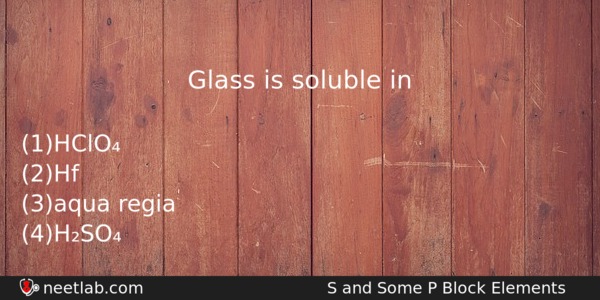
Glass is soluble in
Options
(a) HClO₄
(b) Hf
(c) aqua regia
(d) H₂SO₄
Correct Answer:
Hf
Explanation:
Unlike other halogen acids, HF acid attacks silica and glass. Glass being a mixture of sodium and calcium silicates reacts with HF forming soluble sodium and calcium fluorosilicates respectively. e.g., Na₂SiO₃ + 6HF → Na₂SiF₆ + 3H₂O, CaSiO₃ + 6HF → CaSiF₆ + 3H₂O.
Related Questions: - Primary alcohols can be prepared by the reaction of RMgx with
- In an isobaric process,when temperature changes from T₁ to T₂, ΔS is equal to
- Solution of 0.1 N NH₄OH and 0.1 N NH₄Cl has pH 9.25 . Then fine out pKb of NH₄OH
- The correct order in which the O–O bond length increases in the following is
- CH₃CH₂OH converts into CH₃CHO in the presence of
Topics: S and Some P Block Elements
(157)
Subject: Chemistry
(2512)
Important MCQs Based on Medical Entrance Examinations To Improve Your NEET Score
- Primary alcohols can be prepared by the reaction of RMgx with
- In an isobaric process,when temperature changes from T₁ to T₂, ΔS is equal to
- Solution of 0.1 N NH₄OH and 0.1 N NH₄Cl has pH 9.25 . Then fine out pKb of NH₄OH
- The correct order in which the O–O bond length increases in the following is
- CH₃CH₂OH converts into CH₃CHO in the presence of
Topics: S and Some P Block Elements (157)
Subject: Chemistry (2512)
Important MCQs Based on Medical Entrance Examinations To Improve Your NEET Score
18000+ students are using NEETLab to improve their score. What about you?
Solve Previous Year MCQs, Mock Tests, Topicwise Practice Tests, Identify Weak Topics, Formula Flash cards and much more is available in NEETLab Android App to improve your NEET score.

Share this page with your friends
Leave a Reply