| ⇦ | 
| ⇨ |
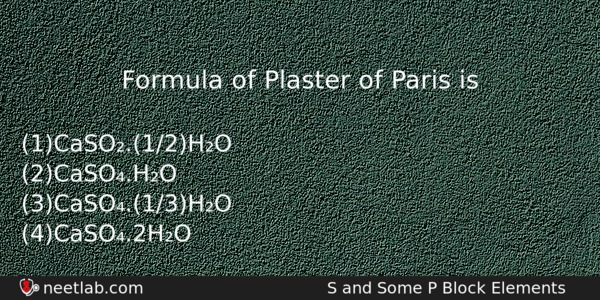
Formula of Plaster of Paris is
Options
(a) CaSO₂.(1/2)H₂O
(b) CaSO₄.H₂O
(c) CaSO₄.(1/3)H₂O
(d) CaSO₄.2H₂O
Correct Answer:
CaSO₂.(1/2)H₂O
Explanation:
Plaster of Paris is CaSO₄. 1/2 H₂O. It is formed by heating the gypsum. CaSO₄. 2H₂O → CaSO₄ . 1/2 H₂O.
Related Questions: - The fcc crystal contains how many atoms in each unit cell
- Schiff’s reagent is
- The indicator used in the titration of iodine against sodium thiosulphate is
- Intermolecular hydrogen bond exists in
- Which of the following compound react with NaHCO3 solution to give sodium salt
Topics: S and Some P Block Elements
(157)
Subject: Chemistry
(2512)
Important MCQs Based on Medical Entrance Examinations To Improve Your NEET Score
- The fcc crystal contains how many atoms in each unit cell
- Schiff’s reagent is
- The indicator used in the titration of iodine against sodium thiosulphate is
- Intermolecular hydrogen bond exists in
- Which of the following compound react with NaHCO3 solution to give sodium salt
Topics: S and Some P Block Elements (157)
Subject: Chemistry (2512)
Important MCQs Based on Medical Entrance Examinations To Improve Your NEET Score
18000+ students are using NEETLab to improve their score. What about you?
Solve Previous Year MCQs, Mock Tests, Topicwise Practice Tests, Identify Weak Topics, Formula Flash cards and much more is available in NEETLab Android App to improve your NEET score.

Share this page with your friends
Leave a Reply