| ⇦ | 
| ⇨ |
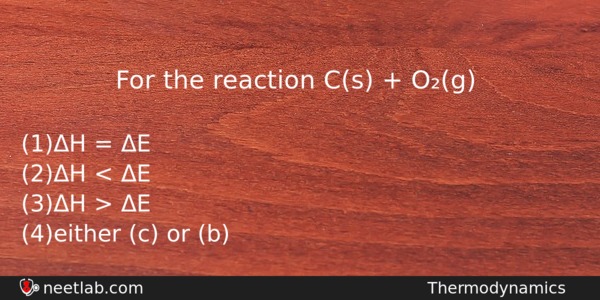
For the reaction C(s) + O₂(g)
Options
(a) ΔH = ΔE
(b) ΔH < ΔE
(c) ΔH > ΔE
(d) either ΔH > ΔE or ΔH < ΔE
Correct Answer:
ΔH = ΔE
Explanation:
In the reaction C(s) + O₂(g) → CO₂(g), there is no change in the number of moles of gaseous components (Δn = 1 – 1 = 0).
As ΔH = ΔE + ΔnRT. Thus in this case ΔH = ΔE.
Related Questions: - The oxide,which can not act as a reducing agent, is
- Treatment of a mixture of CH₃Cl and C₂H₅Cl with sodium in dry ether can generat
- A trend common to both for group I and VII elements in the periodic table
- KCN reacts readily to give a cyanide with
- Number of σ and π- bonds in acetylene is
Topics: Thermodynamics
(179)
Subject: Chemistry
(2512)
Important MCQs Based on Medical Entrance Examinations To Improve Your NEET Score
- The oxide,which can not act as a reducing agent, is
- Treatment of a mixture of CH₃Cl and C₂H₅Cl with sodium in dry ether can generat
- A trend common to both for group I and VII elements in the periodic table
- KCN reacts readily to give a cyanide with
- Number of σ and π- bonds in acetylene is
Topics: Thermodynamics (179)
Subject: Chemistry (2512)
Important MCQs Based on Medical Entrance Examinations To Improve Your NEET Score
18000+ students are using NEETLab to improve their score. What about you?
Solve Previous Year MCQs, Mock Tests, Topicwise Practice Tests, Identify Weak Topics, Formula Flash cards and much more is available in NEETLab Android App to improve your NEET score.

Share this page with your friends
Leave a Reply