| ⇦ | 
| ⇨ |
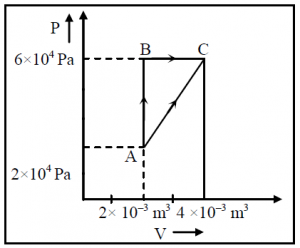
Figure below shows two paths that may be taken by a gas to go from a state A to a state C. In process AB, 400 J of heat is added to the system and in process BC, 100 J of heat is added to the system. The heat absorbed by the system in the process AC will be
Options
(a) 500 J
(b) 460 J
(c) 300 J
(d) 380 J
Correct Answer:
460 J
Explanation:
No explanation available. Be the first to write the explanation for this question by commenting below.
Related Questions: - In the spectrum of hydrogen, the ratio of the longest wavelength in the Lyman series
- A thin rod of length L and mass M is held vertically with one end on the floor
- A ball of mass 2 kg and another of mass 4 kg are dropped together from
- An electron moves on a straight line path XY as shown. The abcd is a coil adjacent
- A satellite is launched into a circular orbit of radius R around earth while
Topics: Thermodynamics
(179)
Subject: Physics
(2479)
Important MCQs Based on Medical Entrance Examinations To Improve Your NEET Score
- In the spectrum of hydrogen, the ratio of the longest wavelength in the Lyman series
- A thin rod of length L and mass M is held vertically with one end on the floor
- A ball of mass 2 kg and another of mass 4 kg are dropped together from
- An electron moves on a straight line path XY as shown. The abcd is a coil adjacent
- A satellite is launched into a circular orbit of radius R around earth while
Topics: Thermodynamics (179)
Subject: Physics (2479)
Important MCQs Based on Medical Entrance Examinations To Improve Your NEET Score
18000+ students are using NEETLab to improve their score. What about you?
Solve Previous Year MCQs, Mock Tests, Topicwise Practice Tests, Identify Weak Topics, Formula Flash cards and much more is available in NEETLab Android App to improve your NEET score.

Share this page with your friends
Leave a Reply