| ⇦ | 
| ⇨ |
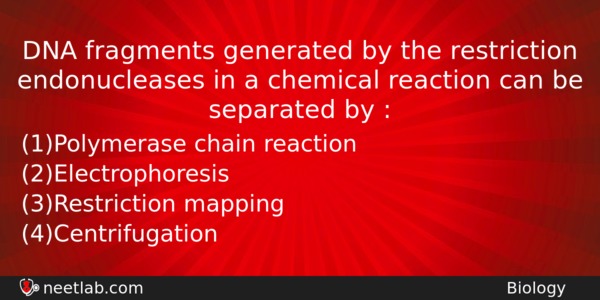
DNA fragments generated by the restriction endonucleases in a chemical reaction can be separated by :
Options
(a) Polymerase chain reaction
(b) Electrophoresis
(c) Restriction mapping
(d) Centrifugation
Correct Answer:
Electrophoresis
Explanation:
DNA fragments generated by restriction endonucleases in a chemical reaction can be separated by gel electrophoresis. Since DNA fragments are negatively charged molecules they can be separated by forcing them to move towards the anode under an electric field through a medium/matrix. The DNA fragments separate according to their size through sieving effect provided by matrix.
Related Questions: - Net primary productivity is
- In which of the following proteins are absent
- A jawless fish, which lays eggs in fresh water and whose ammocoetes larvae after
- The net glomerular filtration rate in an average adult is
- Fastest distribution of some injectible materialmedicine and with no risk
Question Type: Memory
(964)
Difficulty Level: Easy
(1008)
Topics: Biotechnology and Its Applications
(123)
Subject: Biology
(4253)
Important MCQs Based on Medical Entrance Examinations To Improve Your NEET Score
- Net primary productivity is
- In which of the following proteins are absent
- A jawless fish, which lays eggs in fresh water and whose ammocoetes larvae after
- The net glomerular filtration rate in an average adult is
- Fastest distribution of some injectible materialmedicine and with no risk
Question Type: Memory (964)
Difficulty Level: Easy (1008)
Topics: Biotechnology and Its Applications (123)
Subject: Biology (4253)
Important MCQs Based on Medical Entrance Examinations To Improve Your NEET Score
18000+ students are using NEETLab to improve their score. What about you?
Solve Previous Year MCQs, Mock Tests, Topicwise Practice Tests, Identify Weak Topics, Formula Flash cards and much more is available in NEETLab Android App to improve your NEET score.

Share this page with your friends
Leave a Reply