| ⇦ | 
| ⇨ |
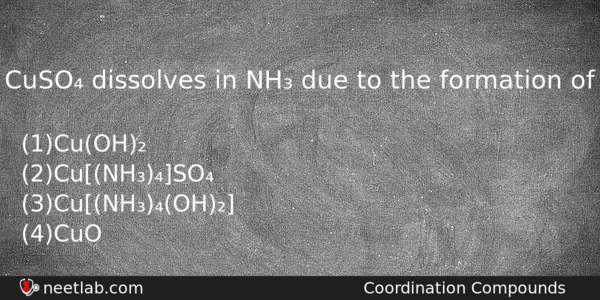
CuSO₄ dissolves in NH₃ due to the formation of
Options
(a) Cu(OH)₂
(b) Cu[(NH₃)₄]SO₄
(c) Cu[(NH₃)₄(OH)₂]
(d) CuO
Correct Answer:
Cu[(NH₃)₄(OH)₂]
Explanation:
NH₃+ H₂O→ NH₄OH
CuSO₄ + NH₄OH → Cu(OH)₂ + (NH₄)₂ SO₄ / Cu(OH)₂ + 2NH₄OH + (NH₄)₂ SO₄ → [Cu (NH₂)₄] SO₄ + 4 H₂O ( Tetrammine cupric sulphate
The complex is called as Schotzer’s reagent which is used for dissolving cellulose in the manufacture of artificial silk.
Related Questions: - Sulphur ion is
- The total number of atomic orbitals in fourth energy level of an atom is :
- Crystalline solids are
- The stability of +1 oxidation state among Al, Ga, In, and TI increases
- In acetylene molecule, the two carbon atoms are linked by
Topics: Coordination Compounds
(87)
Subject: Chemistry
(2512)
Important MCQs Based on Medical Entrance Examinations To Improve Your NEET Score
- Sulphur ion is
- The total number of atomic orbitals in fourth energy level of an atom is :
- Crystalline solids are
- The stability of +1 oxidation state among Al, Ga, In, and TI increases
- In acetylene molecule, the two carbon atoms are linked by
Topics: Coordination Compounds (87)
Subject: Chemistry (2512)
Important MCQs Based on Medical Entrance Examinations To Improve Your NEET Score
18000+ students are using NEETLab to improve their score. What about you?
Solve Previous Year MCQs, Mock Tests, Topicwise Practice Tests, Identify Weak Topics, Formula Flash cards and much more is available in NEETLab Android App to improve your NEET score.

Share this page with your friends
Leave a Reply