| ⇦ | 
| ⇨ |
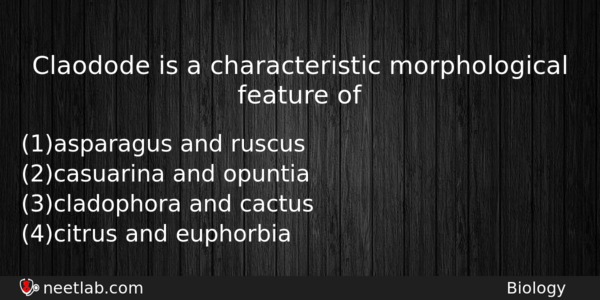
Claodode is a characteristic morphological feature of
Options
(a) asparagus and ruscus
(b) casuarina and opuntia
(c) cladophora and cactus
(d) citrus and euphorbia
Correct Answer:
asparagus and ruscus
Explanation:
It is a modification of the stem the branch of the single internode gets flattened and becomes a leaf like structure. The actual leaves get reduced to scales. From the axils of the scales develops a group of linear acicular structure these are known as cladode. Example: Asparagus, Ruscus.
Related Questions: - Radial vascular bundles occur in
- Night blindness is caused due to the deficiency of
- Which one of the following is not applicable to RNA?
- Net gain of ATP for the oxidation of 1 hexose molecule during aerobic respiration is
- Between the bark and the wood in a woody stem there is a layer of meristem
Question Type: Memory
(964)
Difficulty Level: Easy
(1008)
Topics: Structural Organisation In Plants
(243)
Subject: Biology
(4253)
Important MCQs Based on Medical Entrance Examinations To Improve Your NEET Score
- Radial vascular bundles occur in
- Night blindness is caused due to the deficiency of
- Which one of the following is not applicable to RNA?
- Net gain of ATP for the oxidation of 1 hexose molecule during aerobic respiration is
- Between the bark and the wood in a woody stem there is a layer of meristem
Question Type: Memory (964)
Difficulty Level: Easy (1008)
Topics: Structural Organisation In Plants (243)
Subject: Biology (4253)
Important MCQs Based on Medical Entrance Examinations To Improve Your NEET Score
18000+ students are using NEETLab to improve their score. What about you?
Solve Previous Year MCQs, Mock Tests, Topicwise Practice Tests, Identify Weak Topics, Formula Flash cards and much more is available in NEETLab Android App to improve your NEET score.

Share this page with your friends
Leave a Reply