| ⇦ | 
| ⇨ |
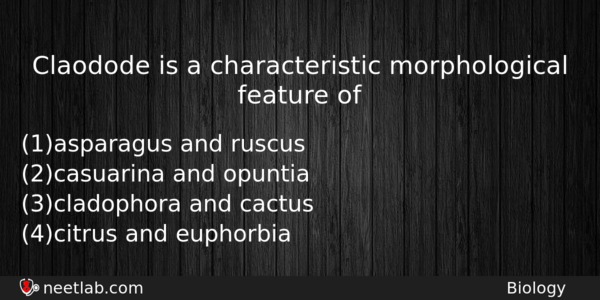
Claodode is a characteristic morphological feature of
Options
(a) asparagus and ruscus
(b) casuarina and opuntia
(c) cladophora and cactus
(d) citrus and euphorbia
Correct Answer:
asparagus and ruscus
Explanation:
It is a modification of the stem the branch of the single internode gets flattened and becomes a leaf like structure. The actual leaves get reduced to scales. From the axils of the scales develops a group of linear acicular structure these are known as cladode. Example: Asparagus, Ruscus.
Related Questions: - Prostaglandins have no role in
- The most common substrate used in distilleries for the production of ethanol is
- Opening and closing of stomata are under the control of
- The idea that life orginates from pre-existing life is referred as
- Rhizophora sp. is characteristic of
Question Type: Memory
(964)
Difficulty Level: Easy
(1008)
Topics: Structural Organisation In Plants
(243)
Subject: Biology
(4253)
Important MCQs Based on Medical Entrance Examinations To Improve Your NEET Score
- Prostaglandins have no role in
- The most common substrate used in distilleries for the production of ethanol is
- Opening and closing of stomata are under the control of
- The idea that life orginates from pre-existing life is referred as
- Rhizophora sp. is characteristic of
Question Type: Memory (964)
Difficulty Level: Easy (1008)
Topics: Structural Organisation In Plants (243)
Subject: Biology (4253)
Important MCQs Based on Medical Entrance Examinations To Improve Your NEET Score
18000+ students are using NEETLab to improve their score. What about you?
Solve Previous Year MCQs, Mock Tests, Topicwise Practice Tests, Identify Weak Topics, Formula Flash cards and much more is available in NEETLab Android App to improve your NEET score.

Share this page with your friends
Leave a Reply