| ⇦ | 
| ⇨ |
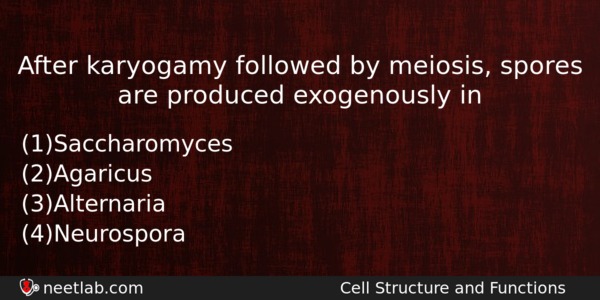
After karyogamy followed by meiosis, spores are produced exogenously in
Options
(a) Saccharomyces
(b) Agaricus
(c) Alternaria
(d) Neurospora
Correct Answer:
Agaricus
Explanation:
In Agaricus (a genus of basidiomycetes), basidiospores or meiospores are produced exogenously.Neurospora (a genus of ascomycetes) produces ascospores as meiospores but endogenously inside the ascus.).• Alternaria (a genus of deuteromycetes) does not produce sexual spores.• Saccharomyces (Unicellular ascomycetes) produces ascospores, endogenously.
Related Questions: - The junction,which helps to stop substances from leaking across a tissue is
- How many plants in the list given below have composite fruits that develop
- Longest phase in Mphase of cell cycle is
- The pyruvic acid formed during glycolysis is oxidised to CO₂ and H₂O in a cycle
- SA node is located in
Topics: Cell Structure and Functions
(413)
Subject: Biology
(4253)
Important MCQs Based on Medical Entrance Examinations To Improve Your NEET Score
- The junction,which helps to stop substances from leaking across a tissue is
- How many plants in the list given below have composite fruits that develop
- Longest phase in Mphase of cell cycle is
- The pyruvic acid formed during glycolysis is oxidised to CO₂ and H₂O in a cycle
- SA node is located in
Topics: Cell Structure and Functions (413)
Subject: Biology (4253)
Important MCQs Based on Medical Entrance Examinations To Improve Your NEET Score
18000+ students are using NEETLab to improve their score. What about you?
Solve Previous Year MCQs, Mock Tests, Topicwise Practice Tests, Identify Weak Topics, Formula Flash cards and much more is available in NEETLab Android App to improve your NEET score.

Share this page with your friends
Leave a Reply