| ⇦ | 
| ⇨ |
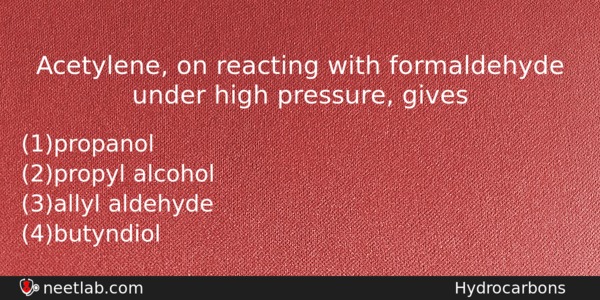
Acetylene, on reacting with formaldehyde under high pressure, gives
Options
(a) propanol
(b) propyl alcohol
(c) allyl aldehyde
(d) butyndiol
Correct Answer:
butyndiol
Explanation:
HC ≡ CH + HCHO (Acetylene) → HC ≡ C – CH₂OH (Formaldehyde)
HC ≡ C – CH₂OH + H – C = O → HOCH₂C ≡ CCH₂OH ( But – 2- yn-1,4-diol)
Related Questions: - Para and ortho-hydrogen differ in
- Which of the following compound react with NaHCO3 solution to give sodium salt
- Biuret test is not given by
- An ion has 18 electrons in the outermost shell, it is
- Which is weakest acid
Topics: Hydrocarbons
(84)
Subject: Chemistry
(2512)
Important MCQs Based on Medical Entrance Examinations To Improve Your NEET Score
- Para and ortho-hydrogen differ in
- Which of the following compound react with NaHCO3 solution to give sodium salt
- Biuret test is not given by
- An ion has 18 electrons in the outermost shell, it is
- Which is weakest acid
Topics: Hydrocarbons (84)
Subject: Chemistry (2512)
Important MCQs Based on Medical Entrance Examinations To Improve Your NEET Score
18000+ students are using NEETLab to improve their score. What about you?
Solve Previous Year MCQs, Mock Tests, Topicwise Practice Tests, Identify Weak Topics, Formula Flash cards and much more is available in NEETLab Android App to improve your NEET score.

Share this page with your friends
C2H2+2HCOH=OHCH2CCCH2OH