| ⇦ | 
| ⇨ |
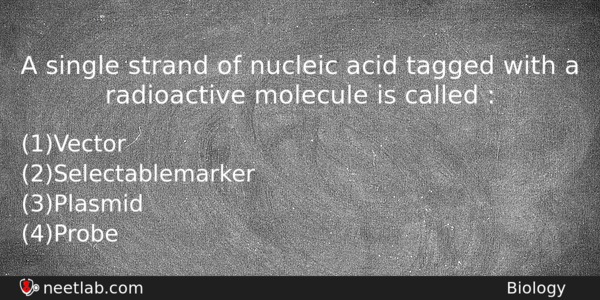
A single strand of nucleic acid tagged with a radioactive molecule is called :
Options
(a) Vector
(b) Selectablemarker
(c) Plasmid
(d) Probe
Correct Answer:
Probe
Explanation:
No explanation available. Be the first to write the explanation for this question by commenting below.
Related Questions: - Cirrhosis of the liver is caused by
- The bonds associated with the secondary structure of protein molecules are
- A dihybrid test cross yielding a result of 1 : 1 : 1 : 1 ratio is indicative of
- which of the following is not a correct statements about taxonomic tools?
- Suicidal bag of plant cell is
Question Type: Memory
(964)
Difficulty Level: Easy
(1008)
Topics: Biotechnology and Its Applications
(123)
Subject: Biology
(4253)
Important MCQs Based on Medical Entrance Examinations To Improve Your NEET Score
- Cirrhosis of the liver is caused by
- The bonds associated with the secondary structure of protein molecules are
- A dihybrid test cross yielding a result of 1 : 1 : 1 : 1 ratio is indicative of
- which of the following is not a correct statements about taxonomic tools?
- Suicidal bag of plant cell is
Question Type: Memory (964)
Difficulty Level: Easy (1008)
Topics: Biotechnology and Its Applications (123)
Subject: Biology (4253)
Important MCQs Based on Medical Entrance Examinations To Improve Your NEET Score
18000+ students are using NEETLab to improve their score. What about you?
Solve Previous Year MCQs, Mock Tests, Topicwise Practice Tests, Identify Weak Topics, Formula Flash cards and much more is available in NEETLab Android App to improve your NEET score.

Share this page with your friends
In molecular biology, a hybridization probe is a fragment of DNA or RNA of variable length which can be radioactively or fluorescently labeled. It can then be used in DNA or RNA samples to detect the presence of nucleotide sequences that are complementary to the sequence in the probe.