| ⇦ | 
| ⇨ |
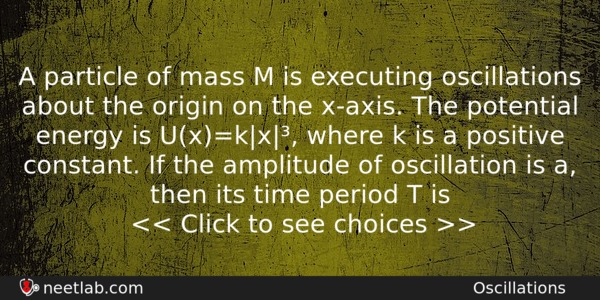
A particle of mass M is executing oscillations about the origin on the x-axis. The potential energy is U(x)=k|x|³, where k is a positive constant. If the amplitude of oscillation is a, then its time period T is
Options
(a) proportional to (1/√a)
(b) independent of a
(c) proportional to a
(d) proportional to a³/₂
Correct Answer:
proportional to (1/√a)
Explanation:
No explanation available. Be the first to write the explanation for this question by commenting below.
Related Questions: - A coil of 100 turns carries a current of 5 mA and creates a magnetic flux of 10⁻⁵ Wb.
- A short magnet of magnetic moment M, is placed on a straight line. The ratio
- Identify the paramagnetic substance
- A disc of moment of inertia (9.8/π²) kg m² is rotating at 600 rpm. If the frequency
- The binding energy per nucleon of ₃⁷Li and ₂⁴He nuclei are 5.60 MeV and 7.06MeV
Topics: Oscillations
(58)
Subject: Physics
(2479)
Important MCQs Based on Medical Entrance Examinations To Improve Your NEET Score
- A coil of 100 turns carries a current of 5 mA and creates a magnetic flux of 10⁻⁵ Wb.
- A short magnet of magnetic moment M, is placed on a straight line. The ratio
- Identify the paramagnetic substance
- A disc of moment of inertia (9.8/π²) kg m² is rotating at 600 rpm. If the frequency
- The binding energy per nucleon of ₃⁷Li and ₂⁴He nuclei are 5.60 MeV and 7.06MeV
Topics: Oscillations (58)
Subject: Physics (2479)
Important MCQs Based on Medical Entrance Examinations To Improve Your NEET Score
18000+ students are using NEETLab to improve their score. What about you?
Solve Previous Year MCQs, Mock Tests, Topicwise Practice Tests, Identify Weak Topics, Formula Flash cards and much more is available in NEETLab Android App to improve your NEET score.

Share this page with your friends
Leave a Reply