| ⇦ | 
| ⇨ |
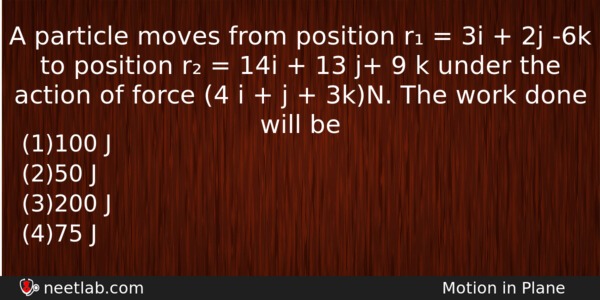
A particle moves from position r₁ = 3i + 2j -6k to position r₂ = 14i + 13 j+ 9 k under the action of force (4 i + j + 3k)N. The work done will be
Options
(a) 100 J
(b) 50 J
(c) 200 J
(d) 75 J
Correct Answer:
100 J
Explanation:
No explanation available. Be the first to write the explanation for this question by commenting below.
Related Questions: - The maximum and minimum magnitudes of the resultant of two vectors
- A charged particle enters a uniform magnetic field with a certain speed at right angles
- In circular coil, when number of turns is doubled and resistance becomes 1/4th
- The magnetic flux linked with a circuit of resistance 100Ω increases from 10 to 60 Wb.
- An inclined plane of length 5.60m making an angle of 45⁰ with the horizontal is placed
Topics: Motion in Plane
(93)
Subject: Physics
(2479)
Important MCQs Based on Medical Entrance Examinations To Improve Your NEET Score
- The maximum and minimum magnitudes of the resultant of two vectors
- A charged particle enters a uniform magnetic field with a certain speed at right angles
- In circular coil, when number of turns is doubled and resistance becomes 1/4th
- The magnetic flux linked with a circuit of resistance 100Ω increases from 10 to 60 Wb.
- An inclined plane of length 5.60m making an angle of 45⁰ with the horizontal is placed
Topics: Motion in Plane (93)
Subject: Physics (2479)
Important MCQs Based on Medical Entrance Examinations To Improve Your NEET Score
18000+ students are using NEETLab to improve their score. What about you?
Solve Previous Year MCQs, Mock Tests, Topicwise Practice Tests, Identify Weak Topics, Formula Flash cards and much more is available in NEETLab Android App to improve your NEET score.

Share this page with your friends
Leave a Reply