| ⇦ | 
| ⇨ |
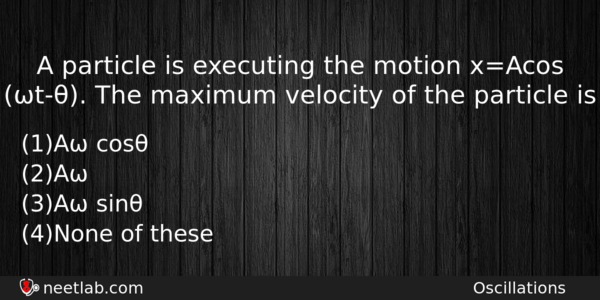
A particle is executing the motion x=Acos (ωt-θ). The maximum velocity of the particle is
Options
(a) Aω cosθ
(b) Aω
(c) Aω sinθ
(d) None of these
Correct Answer:
Aω
Explanation:
x = A cos (ωt – θ)
Velocity = dx/dt = -A sin (ωt – θ)
For maximum value, Since function should be = 1
Maximum velocity = -Aω
Related Questions: - If 20% of a radiactive element decays in 10 days, then amount of original material left
- If the number of radius of ²⁷Al is 3.6 Fermi, the approximate nuclear radius
- If an electron and a proton have the same de-Broglie wavelength, then the kinetic
- The kinetic energy of an electron in the first excited state is
- A ball rolls off the top of stair way with a horizontal velocity of magnitude 1.8 m/s
Topics: Oscillations
(58)
Subject: Physics
(2479)
Important MCQs Based on Medical Entrance Examinations To Improve Your NEET Score
- If 20% of a radiactive element decays in 10 days, then amount of original material left
- If the number of radius of ²⁷Al is 3.6 Fermi, the approximate nuclear radius
- If an electron and a proton have the same de-Broglie wavelength, then the kinetic
- The kinetic energy of an electron in the first excited state is
- A ball rolls off the top of stair way with a horizontal velocity of magnitude 1.8 m/s
Topics: Oscillations (58)
Subject: Physics (2479)
Important MCQs Based on Medical Entrance Examinations To Improve Your NEET Score
18000+ students are using NEETLab to improve their score. What about you?
Solve Previous Year MCQs, Mock Tests, Topicwise Practice Tests, Identify Weak Topics, Formula Flash cards and much more is available in NEETLab Android App to improve your NEET score.

Share this page with your friends
Leave a Reply