| ⇦ | 
| ⇨ |
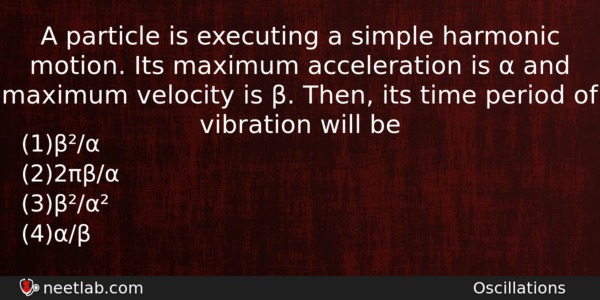
A particle is executing a simple harmonic motion. Its maximum acceleration is α and maximum velocity is β. Then, its time period of vibration will be
Options
(a) β²/α
(b) 2πβ/α
(c) β²/α²
(d) α/β
Correct Answer:
2πβ/α
Explanation:
As, we know, in Simple Harmonic Motion
Maximum acceleration of the particle, α = Aω²
Maximum velocity, β = Aω
⇒ ω = α / β
⇒ T = 2π / ω = 2πβ / α [Since, ω = 2π / T].
Related Questions: - If v is the speed of sound in air, then the shortest length of the closed pipe
- Two bullets are fired simultaneously, horizontally and with different speeds
- Two bulbs 60 W and 100 W designed for voltage 220 V are connected in series
- Three solids of masses m₁,m₂ and m₃ are connected with weightless string
- A body is under stress F and has Young’s modulus Y, then the energy
Topics: Oscillations
(58)
Subject: Physics
(2479)
Important MCQs Based on Medical Entrance Examinations To Improve Your NEET Score
- If v is the speed of sound in air, then the shortest length of the closed pipe
- Two bullets are fired simultaneously, horizontally and with different speeds
- Two bulbs 60 W and 100 W designed for voltage 220 V are connected in series
- Three solids of masses m₁,m₂ and m₃ are connected with weightless string
- A body is under stress F and has Young’s modulus Y, then the energy
Topics: Oscillations (58)
Subject: Physics (2479)
Important MCQs Based on Medical Entrance Examinations To Improve Your NEET Score
18000+ students are using NEETLab to improve their score. What about you?
Solve Previous Year MCQs, Mock Tests, Topicwise Practice Tests, Identify Weak Topics, Formula Flash cards and much more is available in NEETLab Android App to improve your NEET score.

Share this page with your friends
Leave a Reply