| ⇦ | 
| ⇨ |
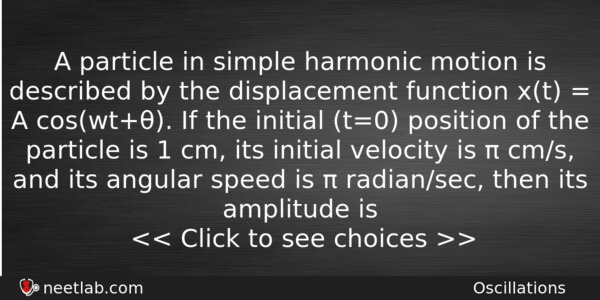
A particle in simple harmonic motion is described by the displacement function x(t) = A cos(wt+θ). If the initial (t=0) position of the particle is 1 cm, its initial velocity is π cm/s, and its angular speed is π radian/sec, then its amplitude is
Options
(a) 1 cm
(b) √2 cm
(c) 2 cm
(d) 2.5 cm
Correct Answer:
√2 cm
Explanation:
No explanation available. Be the first to write the explanation for this question by commenting below.
Related Questions: - A wooden stick 2 m long is floating on the surface of water. The surface tension
- A car moving with a speed of 50 kmh⁻¹ can be stopped by brakes after at least 6 m
- A ball rolls without slipping. The raidus of gyration of the ball about an axis
- A soap bubble is charged to a potential 12V. If its radius is doubled,
- A particle moves in xy plane according to the equation x = 4t² + 5t + 16 and y = 5t
Topics: Oscillations
(58)
Subject: Physics
(2479)
Important MCQs Based on Medical Entrance Examinations To Improve Your NEET Score
- A wooden stick 2 m long is floating on the surface of water. The surface tension
- A car moving with a speed of 50 kmh⁻¹ can be stopped by brakes after at least 6 m
- A ball rolls without slipping. The raidus of gyration of the ball about an axis
- A soap bubble is charged to a potential 12V. If its radius is doubled,
- A particle moves in xy plane according to the equation x = 4t² + 5t + 16 and y = 5t
Topics: Oscillations (58)
Subject: Physics (2479)
Important MCQs Based on Medical Entrance Examinations To Improve Your NEET Score
18000+ students are using NEETLab to improve their score. What about you?
Solve Previous Year MCQs, Mock Tests, Topicwise Practice Tests, Identify Weak Topics, Formula Flash cards and much more is available in NEETLab Android App to improve your NEET score.

Share this page with your friends
Leave a Reply