| ⇦ | 
| ⇨ |
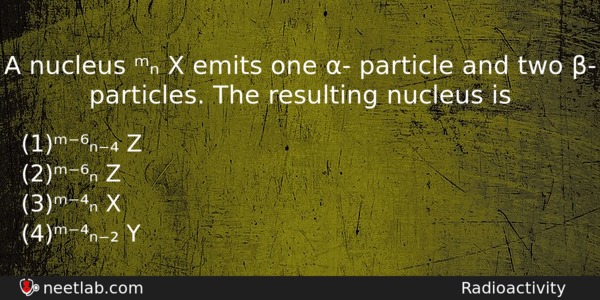
A nucleus ᵐₙ X emits one α- particle and two β- particles. The resulting nucleus is
Options
(a) ᵐ⁻⁶ₙ₋₄ Z
(b) ᵐ⁻⁶ₙ Z
(c) ᵐ⁻⁴ₙ X
(d) ᵐ⁻⁴ₙ₋₂ Y
Correct Answer:
ᵐ⁻⁴ₙ X
Explanation:
When ᵐₙ X emits one α- particle then its atomic mass decreases by 4 units and atomic number4 by 2. Therefore, the new nucleus becomes ᵐ⁻⁴ₙ₋₂ Y. But as it emits two β⁻ particles, its atomic number incre4ases by 2. Thus the resulting nucleus is ᵐ⁻⁴ₙ X.
Related Questions: - The speed of electromagnetic waves in vaccum is equal to
- A spherical drop of capacitance 1μF is broken into eight drops of equal radius.
- In an AC generator, a coil with N turns, all of the same area A and total resistance R,
- The frequencies of X-rays,γ-rays and ultraviolet rays are respectively p,q and r
- An electric current passes through a long straight wire
Topics: Radioactivity
(83)
Subject: Physics
(2479)
Important MCQs Based on Medical Entrance Examinations To Improve Your NEET Score
- The speed of electromagnetic waves in vaccum is equal to
- A spherical drop of capacitance 1μF is broken into eight drops of equal radius.
- In an AC generator, a coil with N turns, all of the same area A and total resistance R,
- The frequencies of X-rays,γ-rays and ultraviolet rays are respectively p,q and r
- An electric current passes through a long straight wire
Topics: Radioactivity (83)
Subject: Physics (2479)
Important MCQs Based on Medical Entrance Examinations To Improve Your NEET Score
18000+ students are using NEETLab to improve their score. What about you?
Solve Previous Year MCQs, Mock Tests, Topicwise Practice Tests, Identify Weak Topics, Formula Flash cards and much more is available in NEETLab Android App to improve your NEET score.

Share this page with your friends
Leave a Reply