| ⇦ | 
| ⇨ |
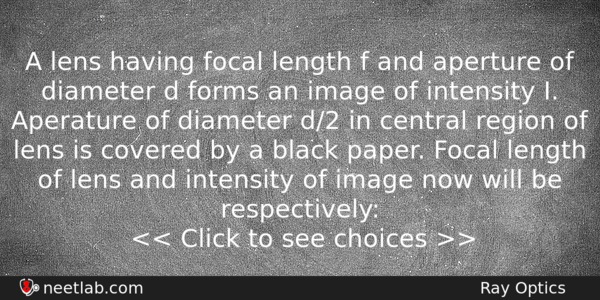
A lens having focal length f and aperture of diameter d forms an image of intensity I. Aperature of diameter d/2 in central region of lens is covered by a black paper. Focal length of lens and intensity of image now will be respectively:
Options
(a) f and I/4
(b) 3f/4 and I/2
(c) f and 3I/4
(d) f/2 and I/2
Correct Answer:
f and 3I/4
Explanation:
By covering aperture, focal length does not change. But intensity is reduced by 1/4 times, as aperture diameter d/2 is covered.
I’ = I – I / 4 = 3I / 4
New focal length = f and intensity = 3I / 4
Related Questions: - In a given process on an ideal gas, dW=0 and dQ<0. Then for the gas
- The electric potential V at any point (x,y,z) all in meters in space is given by
- When a current of (2.5±0.5) A flows through a wire, it develops a potential difference
- A thin wire of length L and mass M is bent to form a semicircle.
- Four point masses, each of value m, are placed at the corners of a square ABCD
Topics: Ray Optics
(94)
Subject: Physics
(2479)
Important MCQs Based on Medical Entrance Examinations To Improve Your NEET Score
- In a given process on an ideal gas, dW=0 and dQ<0. Then for the gas
- The electric potential V at any point (x,y,z) all in meters in space is given by
- When a current of (2.5±0.5) A flows through a wire, it develops a potential difference
- A thin wire of length L and mass M is bent to form a semicircle.
- Four point masses, each of value m, are placed at the corners of a square ABCD
Topics: Ray Optics (94)
Subject: Physics (2479)
Important MCQs Based on Medical Entrance Examinations To Improve Your NEET Score
18000+ students are using NEETLab to improve their score. What about you?
Solve Previous Year MCQs, Mock Tests, Topicwise Practice Tests, Identify Weak Topics, Formula Flash cards and much more is available in NEETLab Android App to improve your NEET score.

Share this page with your friends
Leave a Reply