| ⇦ | 
| ⇨ |
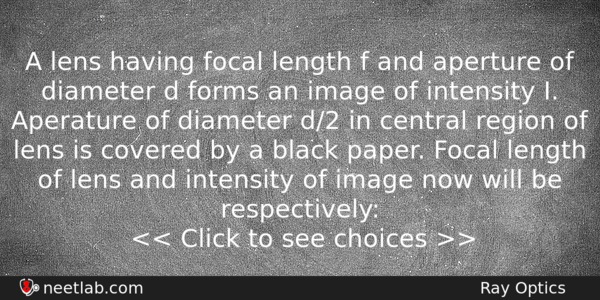
A lens having focal length f and aperture of diameter d forms an image of intensity I. Aperature of diameter d/2 in central region of lens is covered by a black paper. Focal length of lens and intensity of image now will be respectively:
Options
(a) f and I/4
(b) 3f/4 and I/2
(c) f and 3I/4
(d) f/2 and I/2
Correct Answer:
f and 3I/4
Explanation:
By covering aperture, focal length does not change. But intensity is reduced by 1/4 times, as aperture diameter d/2 is covered.
I’ = I – I / 4 = 3I / 4
New focal length = f and intensity = 3I / 4
Related Questions: - A slab consists of two parallel layers of two different materials of same thickness
- A proton is moving in a uniform magnetic field B in a circular path of radius a
- A light of wavelength 5000Å falls on a sensitive plate with photoelectric work
- Large transformers, when used for some time, become hot and are cooled by circulating
- A thin prism of angle 15⁰ made of glass of refractive index µ₁ = 1.5 is combined
Topics: Ray Optics
(94)
Subject: Physics
(2479)
Important MCQs Based on Medical Entrance Examinations To Improve Your NEET Score
- A slab consists of two parallel layers of two different materials of same thickness
- A proton is moving in a uniform magnetic field B in a circular path of radius a
- A light of wavelength 5000Å falls on a sensitive plate with photoelectric work
- Large transformers, when used for some time, become hot and are cooled by circulating
- A thin prism of angle 15⁰ made of glass of refractive index µ₁ = 1.5 is combined
Topics: Ray Optics (94)
Subject: Physics (2479)
Important MCQs Based on Medical Entrance Examinations To Improve Your NEET Score
18000+ students are using NEETLab to improve their score. What about you?
Solve Previous Year MCQs, Mock Tests, Topicwise Practice Tests, Identify Weak Topics, Formula Flash cards and much more is available in NEETLab Android App to improve your NEET score.

Share this page with your friends
Leave a Reply