| ⇦ | 
| ⇨ |
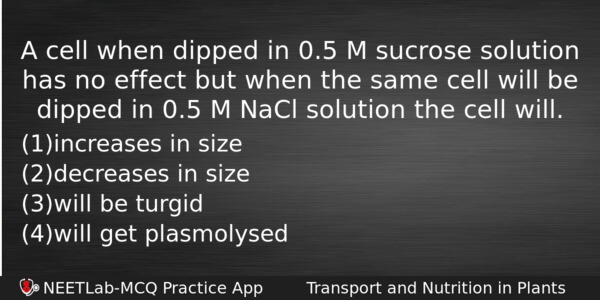
A cell when dipped in 0.5 M sucrose solution has no effect but when the same cell will be dipped in 0.5 M NaCl solution the cell will.
Options
(a) increases in size
(b) decreases in size
(c) will be turgid
(d) will get plasmolysed
Correct Answer:
decreases in size
Explanation:
When the cell is dipped in 0.5 M sucrose solution it has no effect because the solution is isotonic, but in 0.5 M NaCl solution the cell size will decreases because solution is hypertonic in comparison to the cell sap. so water will move out of the cell. The reason behind this is that although both sucrose and NaCl solution are of same molarity yet they differ in osmolarity.NaCl completely dissolves in water and forms two types of solutes.thus 1 M NaCl is equal to 20cm solution (osmole). Hence osmolarity of
Related Questions: - The product of which has been commercialised for lowering blood cholesterol
- Which of the following is non-membranous cell organelle?
- The ovary is half inferior in flowers of
- The basis of grouping of living organisms into eukaryotes and prokaryotes
- The nerve transmitter, produced at the synapse and neromuscular junction, is
Topics: Transport and Nutrition in Plants
(163)
Subject: Biology
(4253)
Important MCQs Based on Medical Entrance Examinations To Improve Your NEET Score
- The product of which has been commercialised for lowering blood cholesterol
- Which of the following is non-membranous cell organelle?
- The ovary is half inferior in flowers of
- The basis of grouping of living organisms into eukaryotes and prokaryotes
- The nerve transmitter, produced at the synapse and neromuscular junction, is
Topics: Transport and Nutrition in Plants (163)
Subject: Biology (4253)
Important MCQs Based on Medical Entrance Examinations To Improve Your NEET Score
18000+ students are using NEETLab to improve their score. What about you?
Solve Previous Year MCQs, Mock Tests, Topicwise Practice Tests, Identify Weak Topics, Formula Flash cards and much more is available in NEETLab Android App to improve your NEET score.

Share this page with your friends
Leave a Reply