| ⇦ | 
| ⇨ |
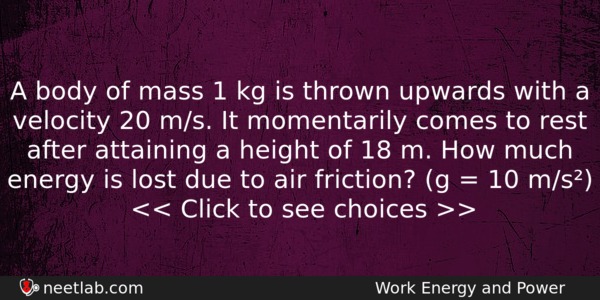
A body of mass 1 kg is thrown upwards with a velocity 20 m/s. It momentarily comes to rest after attaining a height of 18 m. How much energy is lost due to air friction? (g = 10 m/s²)
Options
(a) 30 J
(b) 40 J
(c) 10 J
(d) 20 J
Correct Answer:
20 J
Explanation:
When the body is thrown upwards. its K.E is converted into P.E. The loss of energy due to air friction is the difference of K.E and P.E
1/2 mv² – mgh = 1/2 x 1 x 400 – 1 x 18 x 10
= 200 – 180 = 20 J
Related Questions: - A galvanometer has a resistance 50Ω. A resistance of 5Ω is connected parallel to it.
- Two closed pipes produce 10 beats per second when emitting their fundamental nodes.
- If the binding energy of the nucleon in ₃⁷Li and ₂⁴He nuclei are 5.60 MeV and 7.06 MeV
- An unpolarised beam of intensity I is incident on a pair of nicols making an angle
- Potential at a point x-distance from the centre inside the conducting sphere
Topics: Work Energy and Power
(94)
Subject: Physics
(2479)
Important MCQs Based on Medical Entrance Examinations To Improve Your NEET Score
- A galvanometer has a resistance 50Ω. A resistance of 5Ω is connected parallel to it.
- Two closed pipes produce 10 beats per second when emitting their fundamental nodes.
- If the binding energy of the nucleon in ₃⁷Li and ₂⁴He nuclei are 5.60 MeV and 7.06 MeV
- An unpolarised beam of intensity I is incident on a pair of nicols making an angle
- Potential at a point x-distance from the centre inside the conducting sphere
Topics: Work Energy and Power (94)
Subject: Physics (2479)
Important MCQs Based on Medical Entrance Examinations To Improve Your NEET Score
18000+ students are using NEETLab to improve their score. What about you?
Solve Previous Year MCQs, Mock Tests, Topicwise Practice Tests, Identify Weak Topics, Formula Flash cards and much more is available in NEETLab Android App to improve your NEET score.

Share this page with your friends
Leave a Reply