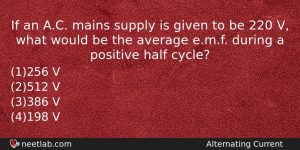
If an A.C. mains supply is given to be 220 V, what would be the average e.m.f.
If an A.C. mains supply is given to be 220 V, what would be the average e.m.f. during a positive half cycle?
Options
(a) 256 V (b) 512 V (c) 386 V (d) 198 […]
If an A.C. mains supply is given to be 220 V, what would be the average e.m.f. during a positive half cycle?
Options
(a) 256 V (b) 512 V (c) 386 V (d) 198 […]

If both the resistance and the inductance in an LR AC series circuit are doubled the new impedance will be
Options
(a) halved (b) fourfold (c) doubled (d) quadrupled
Correct Answer:
doubled
Explanation:
For […]
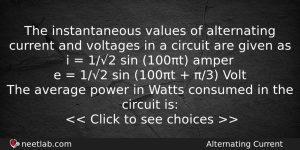
The instantaneous values of alternating current and voltages in a circuit are given as i = 1/√2 sin (100πt) amper e = 1/√2 sin (100πt + π/3) Volt The average power in Watts consumed in […]
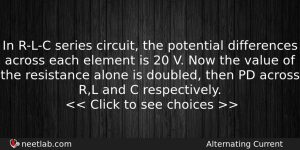
In R-L-C series circuit, the potential differences across each element is 20 V. Now the value of the resistance alone is doubled, then PD across R,L and C respectively.
Options
(a) 20 V, […]
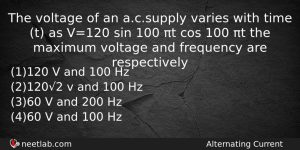
The voltage of an a.c.supply varies with time (t) as V=120 sin 100 πt cos 100 πt the maximum voltage and frequency are respectively
Options
(a) 120 V and 100 Hz (b) 120√2 v […]
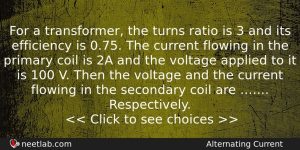
For a transformer, the turns ratio is 3 and its efficiency is 0.75. The current flowing in the primary coil is 2A and the voltage applied to it is 100 V. Then the voltage and […]
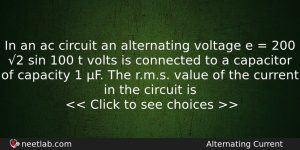
In an ac circuit an alternating voltage e = 200 √2 sin 100 t volts is connected to a capacitor of capacity 1 µF. The r.m.s. value of the current in the circuit is

If the alternating current I=I₁ cosωt+I₂ sinωt, then the rms current is given by
Options
(a) I₁+I₂/√2 (b) │I₁+I₂│/√2 (c) √(I₁²+I₂²/√2) (d) √I₁²+I₂²/√2
Correct Answer:
√(I₁²+I₂²/√2)
Explanation:
No explanation available. Be the first […]
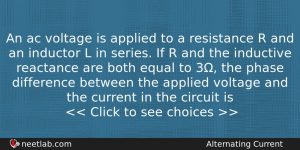
An ac voltage is applied to a resistance R and an inductor L in series. If R and the inductive reactance are both equal to 3Ω, the phase difference between the applied voltage and the […]

Weber ampere per metre is equal to
Options
(a) Joule (b) Henry (c) Newton (d) Watt
Correct Answer:
Newton
Explanation:
weber = (emf) dt = (joule / charge) × time = joule / amp
2017-2025 Copyright Doctor Dreams Training Academy - About Us - Privacy Policy - Terms & Conditions - Contact Us - Refund Policy