| ⇦ | 
| ⇨ |
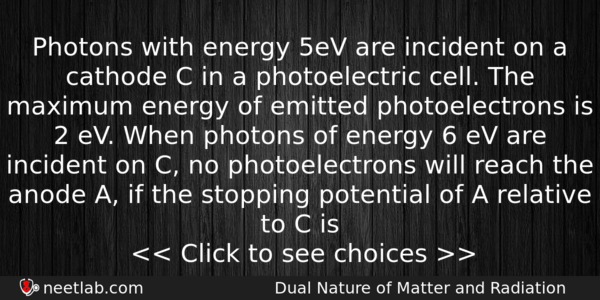
Photons with energy 5eV are incident on a cathode C in a photoelectric cell. The maximum energy of emitted photoelectrons is 2 eV. When photons of energy 6 eV are incident on C, no photoelectrons will reach the anode A, if the stopping potential of A relative to C is
Options
(a) (+3 V)
(b) (+4V)
(c) (- 1V)
(d) (- 3V)
Correct Answer:
(- 3V)
Explanation:
No explanation available. Be the first to write the explanation for this question by commenting below.
Related Questions: - The heart of a man pumps 5 litres of blood through the arteries per minute at
- If F⃗ is the force acting on a particle having position vector r⃗ and ? ⃗ be the torque
- A nucleus ᵐₙ X emits one α- particle and two β- particles. The resulting nucleus is
- A 36 Ω galvanometer is shunted by resistance of 4 Ω. The percentage of the total current
- A cylindrical capacitors has charge Q and length L. If both the charge and length
Topics: Dual Nature of Matter and Radiation
(150)
Subject: Physics
(2479)
Important MCQs Based on Medical Entrance Examinations To Improve Your NEET Score
- The heart of a man pumps 5 litres of blood through the arteries per minute at
- If F⃗ is the force acting on a particle having position vector r⃗ and ? ⃗ be the torque
- A nucleus ᵐₙ X emits one α- particle and two β- particles. The resulting nucleus is
- A 36 Ω galvanometer is shunted by resistance of 4 Ω. The percentage of the total current
- A cylindrical capacitors has charge Q and length L. If both the charge and length
Topics: Dual Nature of Matter and Radiation (150)
Subject: Physics (2479)
Important MCQs Based on Medical Entrance Examinations To Improve Your NEET Score
18000+ students are using NEETLab to improve their score. What about you?
Solve Previous Year MCQs, Mock Tests, Topicwise Practice Tests, Identify Weak Topics, Formula Flash cards and much more is available in NEETLab Android App to improve your NEET score.

Share this page with your friends
Leave a Reply