| ⇦ | 
| ⇨ |
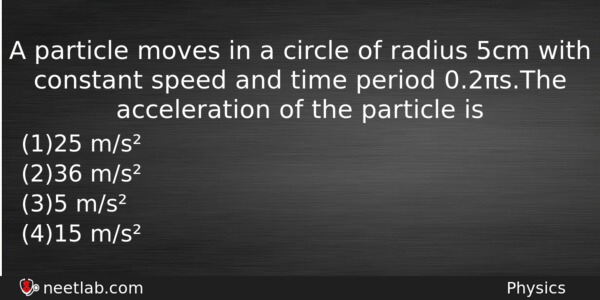
A particle moves in a circle of radius 5 cm with constant speed and time period 0.2πs. The acceleration of the particle is
Options
(a) 15 m/s²
(b) 25 m/s²
(c) 36 m/s²
(d) 5 m/s²
Correct Answer:
5 m/s²
Explanation:
Centripetal acceleration aᵥ = 𝜔²r
= ( 2π / T)² r
= (2π / 0.2π)² x 5 x 10⁻²
= 5 m/s²
Related Questions: - One solid sphere A and another hollow sphere B are of same mass and same outer radii.
- A 70 kg man stands in contact against the inner wall of a hollow cylindrical drum
- To demonstrate the phenomenon of interference, we require two sources which emit
- A galvanometer is converted into an ammeter by connecting
- A particle moves along the x-axis from x=0 to x=5 m under the influence of a force
Question Type: Apply
(15)
Difficulty Level: Easy
(1008)
Topics: Motion in Plane
(93)
Subject: Physics
(2479)
Important MCQs Based on Medical Entrance Examinations To Improve Your NEET Score
- One solid sphere A and another hollow sphere B are of same mass and same outer radii.
- A 70 kg man stands in contact against the inner wall of a hollow cylindrical drum
- To demonstrate the phenomenon of interference, we require two sources which emit
- A galvanometer is converted into an ammeter by connecting
- A particle moves along the x-axis from x=0 to x=5 m under the influence of a force
Question Type: Apply (15)
Difficulty Level: Easy (1008)
Topics: Motion in Plane (93)
Subject: Physics (2479)
Important MCQs Based on Medical Entrance Examinations To Improve Your NEET Score
18000+ students are using NEETLab to improve their score. What about you?
Solve Previous Year MCQs, Mock Tests, Topicwise Practice Tests, Identify Weak Topics, Formula Flash cards and much more is available in NEETLab Android App to improve your NEET score.

Share this page with your friends
Leave a Reply