| ⇦ | 
| ⇨ |
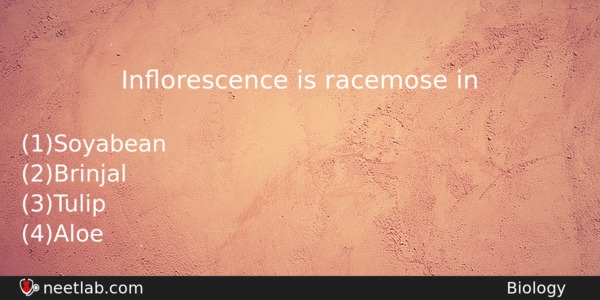
Inflorescence is racemose in
Options
(a) Soyabean
(b) Brinjal
(c) Tulip
(d) Aloe
Correct Answer:
Soyabean
Explanation:
Inflorescence in family fabaceae(e.g.,soyabean) is racemose. Inflorescence in family liliaceae(e.g.,tulip, Aloe) is solitary/cymose; often umbellate. Inflorescence in family solanaceae(e.g.,brinjal) is solitary, axillary or cymose as in Solanum.
Related Questions: - In humans lipofucsin granules are found in
- Bacteria protect themselves from viruses by fragmenting viral DNA with
- The most abundant intracellular cation is:
- Mitochondria is the site for
- In mitochondrial electron transport system for every two pairs of electrons
Question Type: Memory
(964)
Difficulty Level: Easy
(1008)
Topics: Structural Organisation In Plants
(243)
Subject: Biology
(4253)
Important MCQs Based on Medical Entrance Examinations To Improve Your NEET Score
- In humans lipofucsin granules are found in
- Bacteria protect themselves from viruses by fragmenting viral DNA with
- The most abundant intracellular cation is:
- Mitochondria is the site for
- In mitochondrial electron transport system for every two pairs of electrons
Question Type: Memory (964)
Difficulty Level: Easy (1008)
Topics: Structural Organisation In Plants (243)
Subject: Biology (4253)
Important MCQs Based on Medical Entrance Examinations To Improve Your NEET Score
18000+ students are using NEETLab to improve their score. What about you?
Solve Previous Year MCQs, Mock Tests, Topicwise Practice Tests, Identify Weak Topics, Formula Flash cards and much more is available in NEETLab Android App to improve your NEET score.

Share this page with your friends
Leave a Reply