| ⇦ | 
| ⇨ |
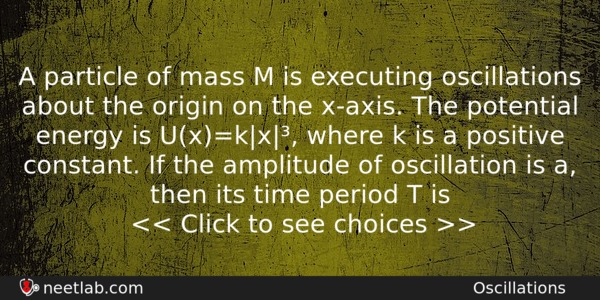
A particle of mass M is executing oscillations about the origin on the x-axis. The potential energy is U(x)=k|x|³, where k is a positive constant. If the amplitude of oscillation is a, then its time period T is
Options
(a) proportional to (1/√a)
(b) independent of a
(c) proportional to a
(d) proportional to a³/₂
Correct Answer:
proportional to (1/√a)
Explanation:
No explanation available. Be the first to write the explanation for this question by commenting below.
Related Questions: - White light reflected from a soap film (Refractive Index =1.5) has a maxima
- A filament bulb (500W,100V) is to be used in a 230V main supply. When a resistance
- Two masses of 9 g and 6 g are connected with a string which is passing over a frictionless
- The minimum wavelength of X-rays emitted by X-ray tube is 0.4125Å
- The moment of inertia of a thin circular disc about an axis passing through its centre
Topics: Oscillations
(58)
Subject: Physics
(2479)
Important MCQs Based on Medical Entrance Examinations To Improve Your NEET Score
- White light reflected from a soap film (Refractive Index =1.5) has a maxima
- A filament bulb (500W,100V) is to be used in a 230V main supply. When a resistance
- Two masses of 9 g and 6 g are connected with a string which is passing over a frictionless
- The minimum wavelength of X-rays emitted by X-ray tube is 0.4125Å
- The moment of inertia of a thin circular disc about an axis passing through its centre
Topics: Oscillations (58)
Subject: Physics (2479)
Important MCQs Based on Medical Entrance Examinations To Improve Your NEET Score
18000+ students are using NEETLab to improve their score. What about you?
Solve Previous Year MCQs, Mock Tests, Topicwise Practice Tests, Identify Weak Topics, Formula Flash cards and much more is available in NEETLab Android App to improve your NEET score.

Share this page with your friends
Leave a Reply