| ⇦ | 
| ⇨ |
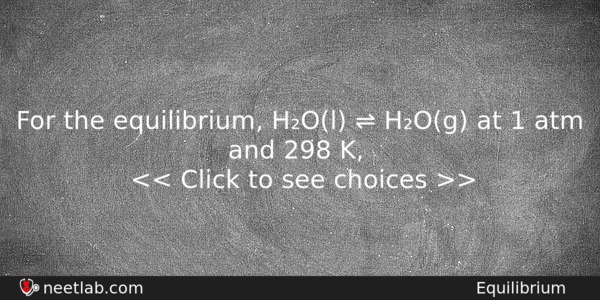
For the equilibrium, H₂O(l) ⇌ H₂O(g) at 1 atm and 298 K,
Options
(a) standard free energy change is equal to zero (ΔG⁰ = 0)
(b) free energy change is less then zero (ΔG⁰ < 0)
(c) standard free energy change is less then zero (ΔG⁰ < 0)
(d) standard free energy change is greater then zero (ΔG⁰ > 0)
Correct Answer:
free energy change is less then zero (ΔG⁰ < 0)
Explanation:
No explanation available. Be the first to write the explanation for this question by commenting below.
Related Questions: - Method used for obtaining highly pure silicon, used as a semiconductor material,
- The ratio of the difference in energy between first and second Bohr orbit
- Solubility of iodine in water may be increased by adding
- Which is weakest acid
- A mixture of calcium acetate and calcium benzoate on dry distillation gives
Topics: Equilibrium
(104)
Subject: Chemistry
(2512)
Important MCQs Based on Medical Entrance Examinations To Improve Your NEET Score
- Method used for obtaining highly pure silicon, used as a semiconductor material,
- The ratio of the difference in energy between first and second Bohr orbit
- Solubility of iodine in water may be increased by adding
- Which is weakest acid
- A mixture of calcium acetate and calcium benzoate on dry distillation gives
Topics: Equilibrium (104)
Subject: Chemistry (2512)
Important MCQs Based on Medical Entrance Examinations To Improve Your NEET Score
18000+ students are using NEETLab to improve their score. What about you?
Solve Previous Year MCQs, Mock Tests, Topicwise Practice Tests, Identify Weak Topics, Formula Flash cards and much more is available in NEETLab Android App to improve your NEET score.

Share this page with your friends
Leave a Reply