| ⇦ | 
| ⇨ |
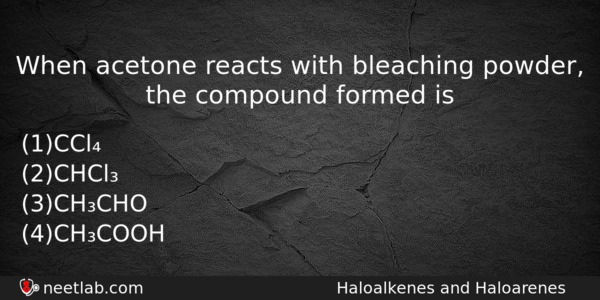
When acetone reacts with bleaching powder, the compound formed is
Options
(a) CCl₄
(b) CHCl₃
(c) CH₃CHO
(d) CH₃COOH
Correct Answer:
CHCl₃
Explanation:
It involves two steps: CaOCl₂(Bleaching powder) + H₂O → Ca(OH)₂ + Cl₂ . (i)Chlorination of acetone to form trichloroacetone. CH₃COCH₃ + 3Cl₂ → CCl₃COCH₃ + 3HCl. (ii) Trichloroacetone is hydrolysed by Ca(OH)₂ present in bleaching powder to give chloroform. 2CCl₃COCH₃ + Ca(OH)₂ → 2CHCl₃(Chloroform) + (CH₃COO)₂Ca(Calcium acetate).
Related Questions: - The inert gas abundantly found in atmosphere is
- The pH of 0.001 N acetic acid solution, which is 10% dissociated, is
- What is the general outer electronic configuration of the coinage metals?
- Among the following the compound that is readily soluble in water is
- According to Dalton’s atomic theory the smallest partical of the matter is called
Topics: Haloalkenes and Haloarenes
(78)
Subject: Chemistry
(2512)
Important MCQs Based on Medical Entrance Examinations To Improve Your NEET Score
- The inert gas abundantly found in atmosphere is
- The pH of 0.001 N acetic acid solution, which is 10% dissociated, is
- What is the general outer electronic configuration of the coinage metals?
- Among the following the compound that is readily soluble in water is
- According to Dalton’s atomic theory the smallest partical of the matter is called
Topics: Haloalkenes and Haloarenes (78)
Subject: Chemistry (2512)
Important MCQs Based on Medical Entrance Examinations To Improve Your NEET Score
18000+ students are using NEETLab to improve their score. What about you?
Solve Previous Year MCQs, Mock Tests, Topicwise Practice Tests, Identify Weak Topics, Formula Flash cards and much more is available in NEETLab Android App to improve your NEET score.

Share this page with your friends
Leave a Reply