| ⇦ | 
| ⇨ |
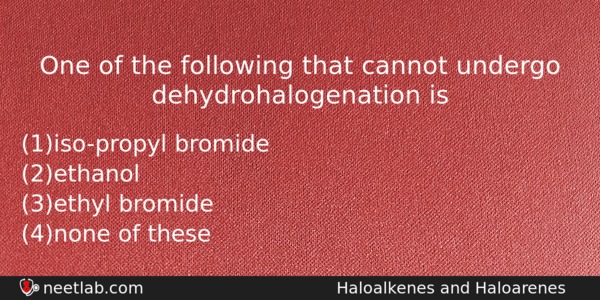
One of the following that cannot undergo dehydrohalogenation is
Options
(a) iso-propyl bromide
(b) ethanol
(c) ethyl bromide
(d) none of these
Correct Answer:
ethanol
Explanation:
No explanation available. Be the first to write the explanation for this question by commenting below.
Related Questions: - Which of these statements about [CO(CN)₆]³⁻ is true
- Cation and anion combines in a crystal to form following types of compound
- Which of the following hydrides is electron deficient molecule?
- Both ethan and methane can be obtained in one step reaction from
- In the following reaction CHCl₃ + C₆H₅NH₂ + 3NaOH → A + 3B + 3C the product
Topics: Haloalkenes and Haloarenes
(78)
Subject: Chemistry
(2512)
Important MCQs Based on Medical Entrance Examinations To Improve Your NEET Score
- Which of these statements about [CO(CN)₆]³⁻ is true
- Cation and anion combines in a crystal to form following types of compound
- Which of the following hydrides is electron deficient molecule?
- Both ethan and methane can be obtained in one step reaction from
- In the following reaction CHCl₃ + C₆H₅NH₂ + 3NaOH → A + 3B + 3C the product
Topics: Haloalkenes and Haloarenes (78)
Subject: Chemistry (2512)
Important MCQs Based on Medical Entrance Examinations To Improve Your NEET Score
18000+ students are using NEETLab to improve their score. What about you?
Solve Previous Year MCQs, Mock Tests, Topicwise Practice Tests, Identify Weak Topics, Formula Flash cards and much more is available in NEETLab Android App to improve your NEET score.

Share this page with your friends
Leave a Reply