| ⇦ | 
| ⇨ |
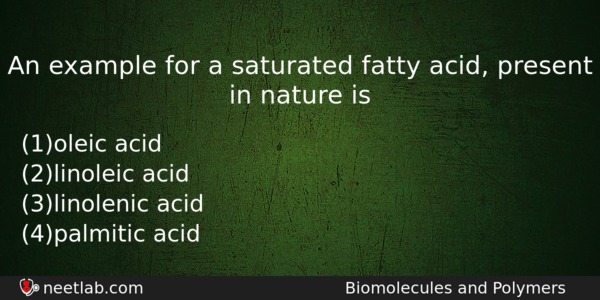
An example for a saturated fatty acid, present in nature is
Options
(a) oleic acid
(b) linoleic acid
(c) linolenic acid
(d) palmitic acid
Correct Answer:
palmitic acid
Explanation:
Oleic acid – C₁₇H₃₃COOH, linoleic acid – C₁₇H₃₁COOH, linolenic acid – C₁₇H₂₉COOH, palmitic acid – C₁₅H₃₁COOH.Saturated monocarboxylic acids form a homologous series which has a general formula C(n)H(2n+1)COOH or C(n)H(2n+1)COOH or C(n)H(2n+1)COOH or C(n)H(2n)O₂. only palmitic acid follows this.
Related Questions: - Which of the following amino acids is basic in nature
- The two ice cubes kept pressed against each other, stick to each other due to
- The common oxidation state shown by lanthanides in their compounds is
- Bleaching powder is prepared from the reaction of
- In Zinc blende structure, the coordination number of the cation is
Topics: Biomolecules and Polymers
(88)
Subject: Chemistry
(2512)
Important MCQs Based on Medical Entrance Examinations To Improve Your NEET Score
- Which of the following amino acids is basic in nature
- The two ice cubes kept pressed against each other, stick to each other due to
- The common oxidation state shown by lanthanides in their compounds is
- Bleaching powder is prepared from the reaction of
- In Zinc blende structure, the coordination number of the cation is
Topics: Biomolecules and Polymers (88)
Subject: Chemistry (2512)
Important MCQs Based on Medical Entrance Examinations To Improve Your NEET Score
18000+ students are using NEETLab to improve their score. What about you?
Solve Previous Year MCQs, Mock Tests, Topicwise Practice Tests, Identify Weak Topics, Formula Flash cards and much more is available in NEETLab Android App to improve your NEET score.

Share this page with your friends
Leave a Reply