| ⇦ | 
| ⇨ |
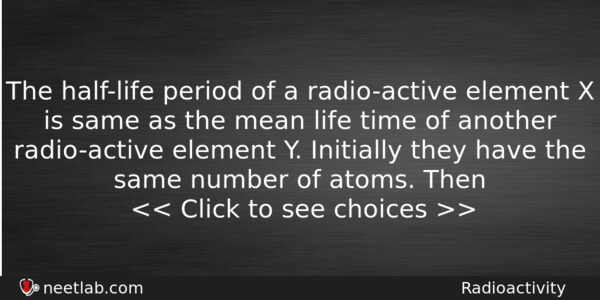
The half-life period of a radio-active element X is same as the mean life time of another radio-active element Y. Initially they have the same number of atoms. Then
Options
(a) X and Y decay at same rate always
(b) X will decay faster than Y
(c) Y will decay faster than X
(d) X and Y have same decay rate initially
Correct Answer:
X will decay faster than Y
Explanation:
No explanation available. Be the first to write the explanation for this question by commenting below.
Related Questions: - If force is proportional to square of velocity, then the dimension of proportionality
- Two resistances 3Ω and 6Ω are connected in parallel
- Ohm’s law is not applicable except to
- The ratio of specific charge of an α-particle to that of a proton is
- On adjusting the P-N junction diode in forward bias,
Topics: Radioactivity
(83)
Subject: Physics
(2479)
Important MCQs Based on Medical Entrance Examinations To Improve Your NEET Score
- If force is proportional to square of velocity, then the dimension of proportionality
- Two resistances 3Ω and 6Ω are connected in parallel
- Ohm’s law is not applicable except to
- The ratio of specific charge of an α-particle to that of a proton is
- On adjusting the P-N junction diode in forward bias,
Topics: Radioactivity (83)
Subject: Physics (2479)
Important MCQs Based on Medical Entrance Examinations To Improve Your NEET Score
18000+ students are using NEETLab to improve their score. What about you?
Solve Previous Year MCQs, Mock Tests, Topicwise Practice Tests, Identify Weak Topics, Formula Flash cards and much more is available in NEETLab Android App to improve your NEET score.

Share this page with your friends
Leave a Reply