| ⇦ | 
| ⇨ |
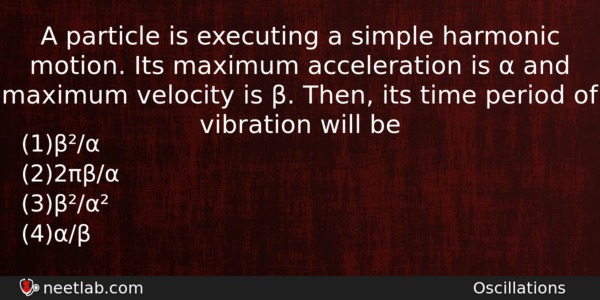
A particle is executing a simple harmonic motion. Its maximum acceleration is α and maximum velocity is β. Then, its time period of vibration will be
Options
(a) β²/α
(b) 2πβ/α
(c) β²/α²
(d) α/β
Correct Answer:
2πβ/α
Explanation:
As, we know, in Simple Harmonic Motion
Maximum acceleration of the particle, α = Aω²
Maximum velocity, β = Aω
⇒ ω = α / β
⇒ T = 2π / ω = 2πβ / α [Since, ω = 2π / T].
Related Questions: - In Wheatstone bridge, three resistors P,Q and R are conncected in three arms
- Heat is flowing through a rod of length 50 cm and area of cross-section 5 cm².
- Two parallel beams of positron moving in the same direction will
- A double slit experiment is performed with light of wavelength 500 nm. A thin film
- At what height h above earth, the value of g becomes g/2 (where R=radius of earth)?
Topics: Oscillations
(58)
Subject: Physics
(2479)
Important MCQs Based on Medical Entrance Examinations To Improve Your NEET Score
- In Wheatstone bridge, three resistors P,Q and R are conncected in three arms
- Heat is flowing through a rod of length 50 cm and area of cross-section 5 cm².
- Two parallel beams of positron moving in the same direction will
- A double slit experiment is performed with light of wavelength 500 nm. A thin film
- At what height h above earth, the value of g becomes g/2 (where R=radius of earth)?
Topics: Oscillations (58)
Subject: Physics (2479)
Important MCQs Based on Medical Entrance Examinations To Improve Your NEET Score
18000+ students are using NEETLab to improve their score. What about you?
Solve Previous Year MCQs, Mock Tests, Topicwise Practice Tests, Identify Weak Topics, Formula Flash cards and much more is available in NEETLab Android App to improve your NEET score.

Share this page with your friends
Leave a Reply