| ⇦ | 
| ⇨ |
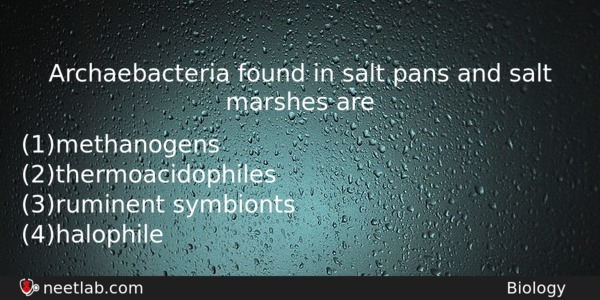
Archaebacteria found in salt pans and salt marshes are
Options
(a) methanogens
(b) thermoacidophiles
(c) ruminent symbionts
(d) halophile
Correct Answer:
halophile
Explanation:
No explanation available. Be the first to write the explanation for this question by commenting below.
Related Questions: - Motile zygote of Plasmodium occurs in
- Which of the following are a group of micronutrients for plants
- Maximum ozone depletion is caused by
- The loss of water in C plants compared to C plants for the same amount of
- Mechanism of ATP production in aerobic respiration was given by
Question Type: Memory
(964)
Difficulty Level: Easy
(1008)
Topics: Diversity In Living World
(339)
Subject: Biology
(4253)
Important MCQs Based on Medical Entrance Examinations To Improve Your NEET Score
- Motile zygote of Plasmodium occurs in
- Which of the following are a group of micronutrients for plants
- Maximum ozone depletion is caused by
- The loss of water in C plants compared to C plants for the same amount of
- Mechanism of ATP production in aerobic respiration was given by
Question Type: Memory (964)
Difficulty Level: Easy (1008)
Topics: Diversity In Living World (339)
Subject: Biology (4253)
Important MCQs Based on Medical Entrance Examinations To Improve Your NEET Score
18000+ students are using NEETLab to improve their score. What about you?
Solve Previous Year MCQs, Mock Tests, Topicwise Practice Tests, Identify Weak Topics, Formula Flash cards and much more is available in NEETLab Android App to improve your NEET score.

Share this page with your friends
Leave a Reply