| ⇦ | 
| ⇨ |
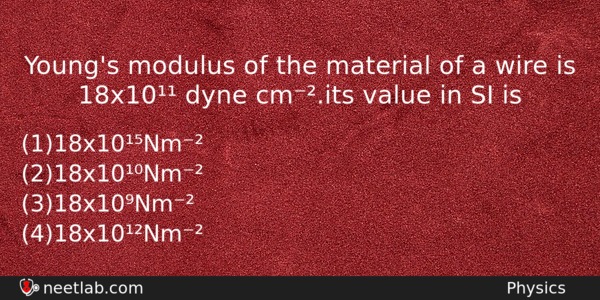
Young’s modulus of the material of a wire is 18 x 10¹¹ dyne cm⁻². Its value in SI is
Options
(a) 18 x 10¹⁵ Nm⁻²
(b) 18 x 10¹⁰ Nm⁻²
(c) 18 x 10⁹ Nm⁻²
(d) 18 x 10¹² Nm⁻²
Correct Answer:
18 x 10¹⁰ Nm⁻²
Explanation:
1 dyne = 10⁻⁵ Newton
1 cm = 10⁻² m
So, 18 x 10¹¹ x 10⁻⁵ / 10⁻⁴
=18 x 10¹⁰ Nm⁻²
Related Questions: - Two conducting spheres of radii 5 cm and 10 cm are given a charge of 15 μC each.
- In Young’s double slit experiment, a third slit is made in between the double slits.
- Find the right condition(s) for Fraunhofer diffraction due to a single slit.
- Two bodies A and B having temperature 327° C and 427° C are radiating heat
- The first line in Lyman series has wavelength λ. The wavelength
Question Type: Memory
(964)
Difficulty Level: Easy
(1008)
Topics: Physical World and Measurement
(103)
Subject: Physics
(2479)
Important MCQs Based on Medical Entrance Examinations To Improve Your NEET Score
- Two conducting spheres of radii 5 cm and 10 cm are given a charge of 15 μC each.
- In Young’s double slit experiment, a third slit is made in between the double slits.
- Find the right condition(s) for Fraunhofer diffraction due to a single slit.
- Two bodies A and B having temperature 327° C and 427° C are radiating heat
- The first line in Lyman series has wavelength λ. The wavelength
Question Type: Memory (964)
Difficulty Level: Easy (1008)
Topics: Physical World and Measurement (103)
Subject: Physics (2479)
Important MCQs Based on Medical Entrance Examinations To Improve Your NEET Score
18000+ students are using NEETLab to improve their score. What about you?
Solve Previous Year MCQs, Mock Tests, Topicwise Practice Tests, Identify Weak Topics, Formula Flash cards and much more is available in NEETLab Android App to improve your NEET score.

Share this page with your friends
Leave a Reply